Healthcare communication is central to the patient experience.
Every appointment request, billing question, follow-up call, or refill inquiry shapes how patients perceive care long before they meet a clinician. As care delivery becomes more distributed and demand continues to grow, healthcare organizations are rethinking how these conversations are handled at scale. This shift is already underway. A recent McKinsey survey found that 85% of healthcare leaders are exploring or using generative AI today, with nearly half already deploying it across operational workflows.
This is where conversational AI for healthcare is increasingly being used as a practical layer within daily operations. Its role is not to replace teams or automate care, but to create a more responsive and reliable way for patients and staff to connect. When designed around real workflows, conversational AI becomes a stabilizing force that improves access, consistency, and clarity across interactions.
This guide explores how conversational AI works in healthcare environments, where it delivers the most value, and how care teams can approach adoption thoughtfully.
In healthcare, conversational AI refers to systems that can listen, understand, and guide patients through real tasks using natural language. These systems do more than answer questions. They help move an interaction forward in a way that aligns with care processes, policies, and patient expectations.
This model reflects where the market is heading. Gartner predicts that by 2029, AI agents will autonomously resolve 80% of common service interactions, significantly reducing operational effort while improving response consistency.
At its core, healthcare conversational AI serves as a communication layer between patients and operational systems. It translates intent into action. That action might be scheduling an appointment, capturing intake information, confirming coverage details, or routing a call with the right context.
What makes this approach effective is that it adapts to how people naturally communicate. Patients do not need to learn new workflows or menus. They explain what they need, and the system responds in a structured yet conversational way.
Healthcare interactions follow patterns, even when they feel complex. Most patient conversations center on a small set of daily needs. Appointment availability, timing changes, insurance clarification, medication requests, and follow-up guidance are consistent across organizations.
Conversational AI is well-suited here because it can reliably handle these patterns while allowing variation in how patients express them. Instead of rigid paths, the system recognizes intent and gathers the necessary details step by step.
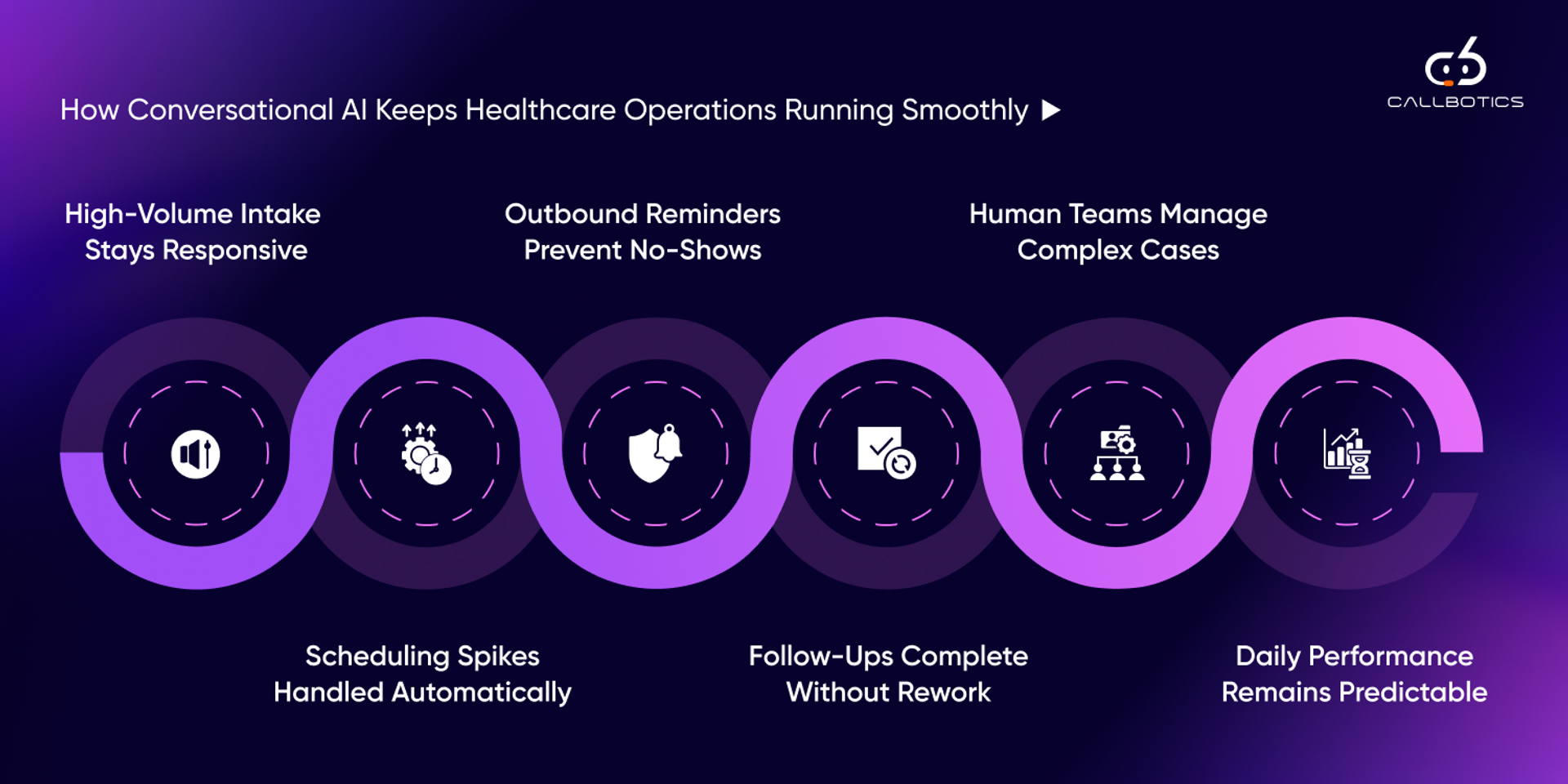
One of the most valuable aspects of conversational AI is how it supports teams. By handling routine conversations, it reduces the volume of repetitive work that consumes staff time. This allows human teams to focus on interactions that require empathy, discretion, or clinical awareness.
This is where AI healthcare assistants are particularly effective. They act as the first layer of interaction, guiding patients through common requests while preserving human involvement for situations that benefit from personal judgment.
Explore how healthcare teams automate intake without losing human judgment →
The best results come when staff are involved early in defining which interactions should remain human-led.
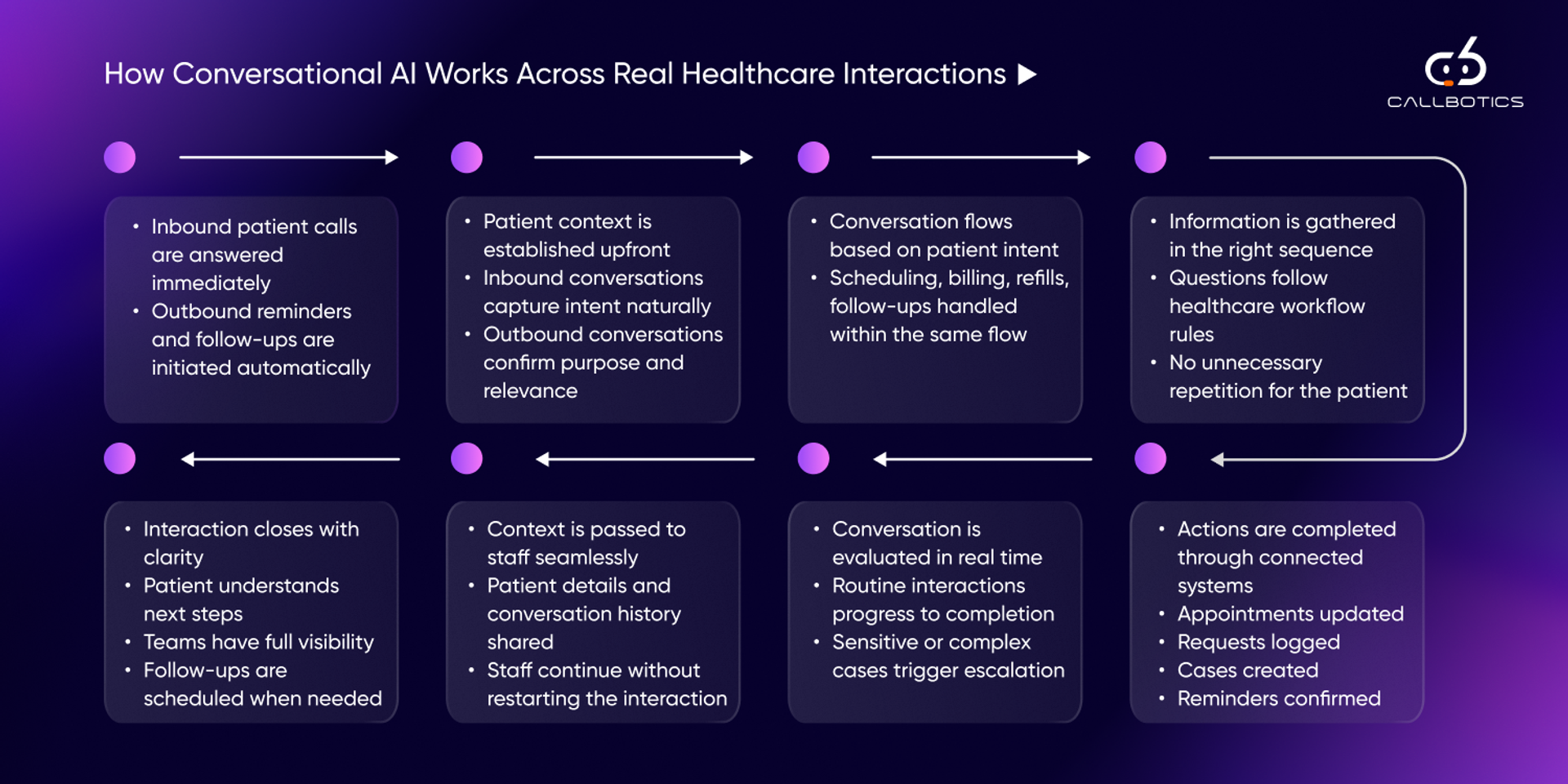
A well-designed conversational AI experience follows a clear flow that mirrors how care teams already operate.
The interaction begins with immediate acknowledgment. Patients are guided to explain their need in their own words. The system listens for intent and confirms understanding before moving forward.
Once intent is clear, the system asks focused questions to gather required details. These questions are sequenced based on workflow logic, not arbitrary scripts.
The system completes the task by interacting with scheduling tools, billing systems, CRM platforms, or care coordination software. Outcomes are recorded automatically, reducing manual follow-up.
When a situation calls for human involvement, the conversation transitions seamlessly. Staff receive the context, information, and status so they can continue without repetition.
Escalation works best when it feels like a continuation, not a transfer.
Voice remains the most trusted and widely used channel in healthcare. Patients often choose to call when timing matters, when instructions feel unclear, or when reassurance is needed.
This is why AI voice agents for healthcare play such an important role. Voice interactions demand a higher level of conversational flexibility. Patients may pause, correct themselves, or change direction mid-conversation. Effective voice agents are designed to handle these dynamics while maintaining progress.
Voice-first conversational AI helps healthcare organizations manage high-volume access points without compromising the experience patients expect.
Text-based interactions are valuable for specific use cases, particularly when patients want written confirmation or are completing simple tasks. In many organizations, healthcare chatbots support intake forms, reminders, educational follow-ups, and basic status checks.
The strongest strategies align chat and voice under a shared logic so that patients experience consistency regardless of how they reach out.
Consistency across channels reduces confusion and builds trust over time.
Early success with conversational AI often comes from focusing on workflows that are frequent, well-defined, and measurable.
| Use case | Why it fits well | Operational outcome |
|---|---|---|
| Appointment scheduling and updates | High volume and predictable rules | Faster access and fewer delays |
| Reminders and confirmations | Prevents avoidable gaps | Improved attendance |
| Billing and coverage questions | Common and repeatable | Reduced repeat contacts |
| Prescription refill requests | Structured protocols | Cleaner routing and tracking |
| Post-visit follow-ups | Reinforces care plans | Better continuity |
Once conversational AI is embedded into real workflows, its impact becomes visible quickly. The value does not come from novelty or automation volume. It comes from predictability. Patients know they will be acknowledged. Staff know requests will be captured accurately. Leaders know performance will not fluctuate wildly with call spikes.
The most successful healthcare teams focus on outcomes that matter operationally and clinically.
Access is the first signal of care quality. When patients reach out, speed and clarity shape their confidence.
Conversational AI improves access by ensuring that every request is acknowledged immediately and guided forward. This consistency reduces abandoned calls, prevents backlog accumulation, and smooths demand across the day.
More importantly, it does this without requiring proportional increases in staffing. Teams gain breathing room while maintaining service levels.
Access improvements often show up first in reduced call abandonment and shorter peak-time queues.
Administrative work is unavoidable in healthcare, but much of it follows repeatable patterns. Scheduling changes, eligibility questions, refill requests, and follow-up confirmations consume a large share of operational time.
Conversational AI absorbs these interactions and executes them consistently. Tasks are completed, logged, and routed without manual intervention. Staff time shifts toward coordination, exception handling, and patient-facing support.
Over time, this creates a healthier balance between operational load and staff capacity.
Patients often interact with healthcare organizations multiple times around a single episode of care. When information is lost or fragmented, frustration increases and resolution slows.
Conversational AI improves continuity by maintaining context across interactions. Information captured during intake informs follow-ups. Previous actions are visible. Conversations feel connected rather than episodic.
This continuity benefits patients and staff alike.
Continuity improves patient trust even when outcomes are unchanged.
Human-led communication varies naturally. Tone, pacing, and clarity shift across individuals and time of day. Conversational AI introduces consistency while preserving flexibility.
Patients receive clear explanations, predictable guidance, and steady progression regardless of when they reach out. This reliability becomes especially valuable during high-volume periods when variability tends to increase.
Consistency supports both patient satisfaction and operational stability.
The first successful workflow often becomes the blueprint for expanding automation responsibly.
Automation alone is not a useful success metric in healthcare. The most meaningful indicators reflect patient progress and operational clarity.
Effective measurement focuses on a balanced set of signals.
| Metric category | What it reveals | Why it matters |
|---|---|---|
| Time to first response | Access speed | Sets patient confidence early |
| Interaction resolution rate | Outcome completion | Shows real task ownership |
| Transfer quality | Escalation effectiveness | Preserves continuity |
| Repeat contact rate | Clarity and accuracy | Indicates friction points |
| Staff intervention time | Capacity impact | Measures workload shift |
Teams that review these metrics regularly gain visibility into where workflows are working well and where refinement is needed.
See how outcome-driven conversational AI performs in live healthcare environments →
Measurement becomes even more important given governance gaps. Deloitte research shows that while most organizations expect AI to transform operations, only a quarter feel fully prepared to manage governance and risk, making clear metrics essential from the start.
Review resolution trends weekly during early rollout to catch friction before it compounds.
Healthcare environments require trust, accountability, and traceability. Conversational AI must align with these expectations from day one.
Each automated interaction should have a defined scope. The system needs to know what it can complete independently and when to involve staff. These boundaries are operational safeguards, not limitations.
Escalation rules should be explicit and documented. They guide how emotional signals, uncertainty, or policy constraints trigger human involvement.
Conversational AI platforms used in healthcare must also align with regulatory requirements such as HIPAA, along with applicable state and federal data protection standards. This includes secure handling of protected health information, role-based access controls, audit-ready logs, and safeguards that support compliance across voice and digital interactions.
Governance works best when it is embedded into workflows rather than layered on later.
Short-term pilots often succeed technically but stall operationally. Long-term success comes from designing with scale and change in mind.
This includes:
Conversational AI improves with use. Each interaction reveals patterns that inform refinement. Teams that treat deployment as an evolving capability rather than a one-time project see compounding returns.
At this stage, most healthcare teams move from conceptual alignment to practical evaluation. The core question becomes whether conversational AI can perform reliably under real operating pressure.
Healthcare contact centers do not operate in controlled environments. Call volume fluctuates. Patient intent changes mid-conversation. Emotions vary. Escalation must be dependable. Systems must respond consistently during peak periods, not just during demos.
This is where outcome-focused design matters more than feature lists.
CallBotics is an enterprise-ready conversational AI platform built specifically for call-heavy contact center environments, including healthcare access and patient support operations. The platform is designed around real operating conditions rather than ideal scenarios, which makes it well-suited for healthcare teams managing fluctuating call volumes and time-sensitive interactions.
What differentiates CallBotics is its focus on resolution. Conversations are designed to move from intake to outcome, not stop at routing or deflection. This is especially important in healthcare workflows, including appointment management, billing inquiries, follow-ups, and high-volume intake.
This approach allows healthcare teams to stabilize access, reduce repetitive administrative load, and maintain clear visibility into performance without increasing operational complexity.
CallBotics supports the high-impact workflows discussed earlier in this guide, including appointment scheduling and changes, billing and coverage questions, prescription refill routing, and post-visit follow-ups. Each workflow is designed to preserve human judgment while removing friction from routine interactions.
For healthcare leaders evaluating conversational AI, CallBotics offers a practical model that prioritizes faster time-to-value, predictable performance, and measurable improvements in patient conversations.
For teams evaluating conversational AI within healthcare operations, the following resources provide additional context and depth.
These resources expand on the concepts covered in this guide and provide practical insight into how conversational AI supports real-world performance.
Successful healthcare deployments share a few common characteristics.
Conversational AI performs best when it is treated as operational infrastructure rather than a pilot project. When introduced with intention, it strengthens how care teams communicate and how patients experience access.

See how enterprises automate calls, reduce handle time, and improve CX with CallBotics.
CallBotics is an enterprise-ready conversational AI platform, built on 18+ years of contact center leadership experience and designed to deliver structured resolution, stronger customer experience, and measurable performance.