Net Promoter Score (NPS) measures how likely customers are to recommend a company. In reality, that score is heavily shaped inside the contact center, where speed, resolution, and consistency define the customer’s final impression. One poor interaction, long wait times, repeated explanations, or unresolved queries can quickly turn a promoter into a detractor.
The stakes are higher than ever in 2026. Research shows that:
These numbers highlight a critical shift: NPS is no longer influenced by brand perception alone; it is operationally earned in every interaction.
AI voice agents are being introduced to directly address these pressure points. When deployed correctly, they can:
This means AI voice agents are not just automation tools. They act as operational stabilizers for the exact variables that drive NPS:
Net Promoter Score, or NPS, is a simple way to measure customer loyalty. It is based on one question: How likely is a customer to recommend your company to someone else? The answer helps show whether customers are leaving interactions with trust and confidence, or with frustration.
In most businesses, contact centers have a bigger impact on NPS than teams realize. That is because support conversations often happen at the moments that matter most, when a customer needs help, wants a clear answer, or is already frustrated. If the experience is smooth, fast, and helpful, it strengthens trust. If it is slow, repetitive, or unresolved, it can damage the relationship very quickly.
This is why contact center performance is closely tied to customer loyalty. Customers do not separate the service experience from the brand itself. They remember how easy it was to get help, how long they had to wait, whether they had to repeat themselves, and whether their issue was actually resolved.
Put simply, NPS is not determined solely by brand messaging. It is shaped by real service experiences. And for many companies, the contact center is where that experience is won or lost.
These three metrics are often discussed together, but they do not measure the same thing. That is why teams can get confused when one score improves, and another does not. The best way to use them is to treat each one as a different signal.
If you track the right metric for the right goal, it becomes much easier to understand what is actually improving and what still needs attention.
NPS measures long-term customer loyalty. It is based on a simple question: How likely are you to recommend this company to someone else? That makes it broader than a single support call.
A customer may have one decent interaction and still give a low NPS score if they no longer trust the brand. On the other hand, a customer may tolerate a small issue and still remain a promoter because their overall experience has been consistently strong. This is why NPS is best used to understand overall brand sentiment, not just contact center performance in isolation.
That said, contact centers still influence it heavily. Fast answers, better resolution, and less frustration all shape how customers remember the brand.
CSAT measures how satisfied a customer was with a specific interaction, such as a support call or service request. It is usually asked right after the conversation, while the experience is still fresh.
This makes CSAT useful for understanding how well a call went in the moment. Did the customer get help quickly? Was the answer clear? Did the agent or system solve the issue? These are the kinds of things CSAT helps measure.
In simple terms, CSAT is about the quality of one interaction, not the full customer relationship.
CES stands for Customer Effort Score. It measures how easy or difficult it was for a customer to get their issue resolved.
This metric is closely tied to friction. Long wait times, multiple transfers, repeating the same information, unclear menus, and having to call back again all increase effort. Even if the issue is eventually resolved, high effort can still leave the customer with a poor impression.
CES is especially useful for contact centers because it helps teams spot where the experience feels harder than it should. If customers have to work too much to get help, loyalty usually drops with it.
Eliminate wait times and start every interaction with instant response using CallBotics.Customers are more likely to recommend a brand when support feels easy, quick, and reliable. In most cases, NPS does not improve because of one impressive moment. It improves because the customer feels that the company respected their time, understood the issue, and handled it well.
That is why the biggest drivers of NPS in contact centers are usually very practical. Customers want fast access to help, clear answers, smooth resolution, and a conversation that does not feel frustrating. When those basics are done well, trust grows. When they are not, loyalty drops quickly.
Speed matters from the very beginning. If a customer has to wait too long just to reach support, frustration starts building before the actual conversation even begins.
This is important because long hold times create a negative impression that is hard to undo later. Even if the issue gets solved in the end, the customer still remembers the delay, the uncertainty, and the effort it took to get there. In many cases, that is enough to lower the chance of recommending the brand.
Fast access to help sends a very different message. It tells the customer that the company is responsive and prepared to support them when needed.
Customers trust brands more when issues are resolved quickly and correctly the first time. They do not want to call back, chase updates, or wonder whether the problem was actually fixed.
That is why first-call resolution has such a strong impact on NPS. It reduces effort, saves time, and gives the customer confidence that the company knows how to handle the issue. A quick, clear outcome feels reliable. And reliability is a big part of loyalty.
In simple terms, customers are more likely to recommend a brand when support does not leave loose ends behind.
Support is not only about solving the issue. It is also about how the interaction feels while it is happening. Customers notice tone, clarity, and whether the conversation feels smooth or confusing.
When support feels calm, clear, and respectful, customers are more likely to leave with a positive impression, even if the issue itself was not simple. But when the experience feels robotic, rushed, dismissive, or hard to follow, trust can drop quickly.
This is where brand perception gets shaped in real time. Customers often judge the company by the quality of the conversation, not just the final answer.
Few things frustrate customers more than repeating the same details again and again. It makes the experience feel disconnected and inefficient.
This usually happens when calls are transferred, context is lost, or support systems do not carry information forward properly. From the customer’s point of view, it feels like the company is not listening or is not organized enough to help smoothly.
That is why reducing repetition matters so much for NPS. A connected experience feels easier, more respectful, and more professional. It shows the customer that their time matters and that the brand can handle support without creating unnecessary friction.
AI voice agents improve NPS when they make support feel faster, easier, and more reliable for the customer. The real impact does not come from automation alone. It comes from reducing the moments that create frustration and improving the moments that build trust. When used well, AI voice agents help contact centers deliver a smoother experience without making the interaction feel disconnected or confusing.
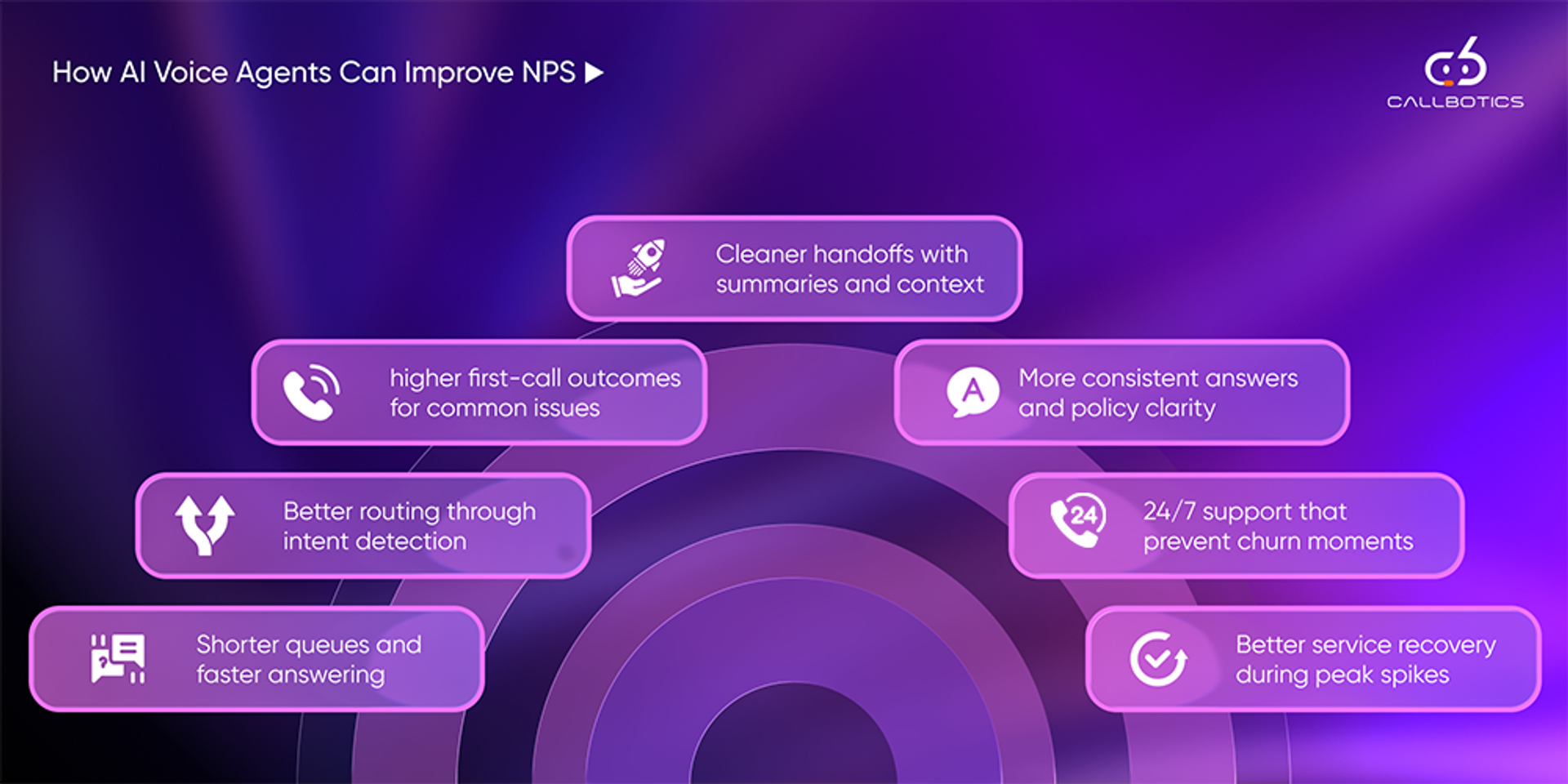
One of the fastest ways to improve customer perception is to reduce the wait before the conversation even starts. When customers get help quickly, the interaction begins with less frustration and more confidence. That first impression matters because long hold times often shape the emotional tone of the entire experience, even if the issue is solved later.
AI voice agents can identify the reason for the call early and route the customer to the right workflow, team, or next step faster. This makes the experience feel more direct and less tiring. Customers do not want to explain their issue multiple times or get moved around before reaching the right place.
Many support calls are about recurring needs such as scheduling, order status, account updates, payment questions, or simple FAQs. AI voice agents can handle these common interactions quickly and consistently, which helps more customers get what they need in a single conversation. That kind of fast resolution has a direct effect on trust.
Not every issue should be fully handled by AI, and that is fine. What matters is whether the handoff to a human feels smooth. When AI captures the reason for the call, verifies details, and passes a summary forward, the human agent can continue the conversation without starting over. That creates a much better customer experience.
Customers lose trust when they hear a different answer every time they contact support. AI voice agents can help reduce that problem by following the same approved logic, workflows, and policy rules across interactions. This makes support feel more dependable and reduces confusion.
Problems do not always happen during business hours. When customers need help at night, on weekends, or during busy periods, the ability to reach support still matters. AI voice agents can provide immediate after-hours help for many common issues, which reduces anxiety and helps the brand stay responsive when it matters most.
Service quality often drops during seasonal surges, campaign spikes, outages, or unexpected volume increases. That is when long waits, rushed conversations, and missed follow-ups start hurting the customer experience. AI voice agents can absorb part of that surge and help keep support stable, so the experience does not fall apart when demand rises.
AI voice agents can improve customer loyalty, but only when the experience feels helpful and well managed. When the setup is poor, the opposite happens. Customers do not get frustrated because AI is involved. They get frustrated when the interaction feels slow, confusing, or unhelpful.
That is why it is important to understand the failure modes before launch. Most NPS damage comes from a few predictable problems: wrong answers, unnecessary friction, weak transfers, and no clear path to a human. These issues are avoidable, but only if teams design for them from the start.
The fastest way to damage trust is to give a confident answer that turns out to be wrong. Customers can usually forgive a delay or a handoff. They are much less forgiving when the system gives misleading information about something important, especially around billing, appointments, claims, orders, or policy details.
This is why AI voice agents need clear boundaries. It is better for the system to say it does not know, or to escalate the call, than to guess. Good escalation rules protect trust because they prevent the experience from getting worse. In customer support, a careful answer is always better than a fast but incorrect one.
Customers call support because they want help, not a long scripted introduction. If the conversation starts with too much explanation, too many prompts, or unnecessary questions, the experience begins to feel slow and mechanical. That frustration builds quickly, especially when the issue is simple.
A better approach is to keep the opening short, clear, and focused on the reason for the call. Ask only what is needed, and confirm important details in a simple way. Short prompts make the experience feel faster. Clear confirmations help the customer feel understood without making the conversation feel repetitive.
Not every issue should stay inside an automated flow. Some situations are urgent, emotional, complex, or simply not a good fit for AI. If customers feel trapped in automated systems with no clear way to reach a person, frustration rises quickly. In those moments, the system stops feeling efficient and starts feeling like a barrier.
That is why every AI voice experience needs an easy and visible path to a human. Customers should not have to fight the system to get help. A clear escape route builds confidence because it shows the company is using automation to support the experience, not to block access when the issue becomes more serious.
Transfers are not always the problem. The real problem is when the transfer happens badly. If a customer spends time explaining the issue, gives their details, and then has to repeat everything again to the next person, the experience immediately feels broken. It creates the impression that the company is not internally connected.
This kind of repetition hurts patience and trust at the same time. It makes the customer feel unheard and increases the effort required to resolve the issue. Good handoffs should carry context forward so the next agent can continue the conversation rather than restart it. When context is lost, detractors increase because the support experience feels harder than it should.
Not every AI voice use case improves customer loyalty at the same speed. The safest places to start are the ones where customers want a quick answer, a clear outcome, and as little effort as possible. These use cases reduce friction without adding unnecessary complexity, which makes them strong starting points for improving NPS.
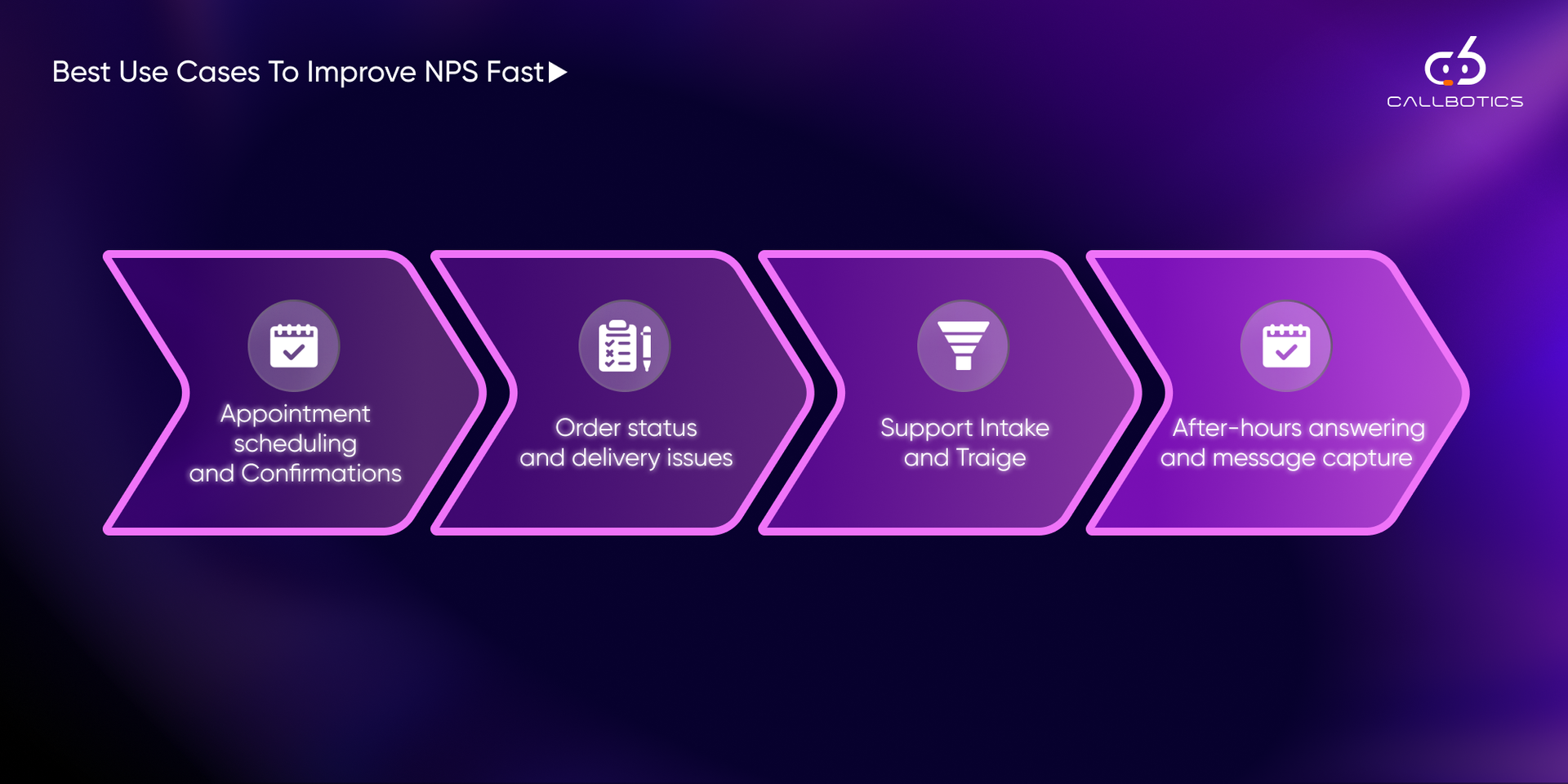
Appointment scheduling is a strong starting use case because customers usually want one simple outcome: book, confirm, reschedule, or cancel without delay. When that process is fast and clear, it builds confidence. Customers feel the business is easy to deal with, which directly improves their perception of the brand.
Order status calls are high-volume, repetitive, and usually urgent from the customer’s perspective. People do not want to wait in a queue just to ask where something is or when it will arrive. When these questions are handled quickly, it removes a major source of frustration and makes support feel more responsive.
Support intake is a good use case because it improves the experience before the actual resolution even begins. If the system captures the reason for the call, gathers the right details, and routes the customer correctly, the next step becomes faster and less frustrating. This is especially useful for issues that still need a human agent.
Missed calls after business hours often leave a bad impression, especially when the customer feels ignored or does not know what happens next. After-hours answering helps protect trust by making sure the customer still reaches something useful, even when live teams are unavailable. A simple response and clear message capture can prevent a negative experience from forming in the first place.
Measuring NPS impact is not just about looking at one number before and after AI is introduced. NPS is influenced by many parts of the business, so if you only track the overall score, it is easy to draw the wrong conclusion. The goal is to understand where AI is improving the experience and where it is not.
To do this well, teams need to break NPS down into smaller, more meaningful views and combine it with other signals. This makes it easier to see whether changes in customer loyalty are actually coming from the contact center experience.
Looking at overall NPS alone can hide what is really happening. For example, if AI is handling simple queries well but struggling with complex ones, the overall score may look flat, even though there are clear improvements and issues underneath.
That is why it is important to track NPS by segment. This can include call type, customer group, issue category, or whether the interaction involved AI, human agents, or both. When you break it down this way, patterns become clearer, and you can see exactly where AI is helping and where it needs improvement.
NPS usually changes slowly because it reflects overall perception, not just one interaction. If you wait only for NPS to move, you may miss early signals that something is improving or getting worse.
This is where CES and CSAT become useful. If customers are finding it easier to get help and are more satisfied with individual interactions, those changes often show up in CES and CSAT first. Over time, these improvements tend to influence NPS as well. In simple terms, effort and satisfaction are early signals, while NPS is the long-term result.
Customer loyalty is strongly influenced by a few key operational factors. Long wait times, repeated transfers, unresolved issues, and having to call back again all increase frustration. These are not just operational problems; they are direct drivers of NPS.
That is why teams should track metrics like wait time, number of transfers, first-call resolution (FCR), and repeat contacts. When these improve, NPS usually follows. By focusing on these signals, you can predict how customer perception is likely to change, instead of waiting for survey results to tell you later.
Improving NPS is not about adding automation for the sake of it. It comes from making support feel faster, easier, and more reliable for the customer. That means reducing wait time, understanding intent early, resolving common issues without unnecessary effort, and making sure handoffs do not break the experience. When those parts work well together, customers are more likely to leave the interaction with trust instead of frustration.
CallBotics helps teams build AI voice agent experiences around those outcomes. Instead of treating voice AI as a simple answering layer, the platform supports structured call handling that helps customers get to the right outcome faster. Over time, that leads to better service experiences, stronger confidence in support, and a better foundation for customer loyalty.
What helps improve NPS with CallBotics:
AI voice agents impact NPS in a very simple way. They shape how the customer feels during and after the interaction. When the experience is fast, clear, and easy to navigate, customers are more likely to trust the brand and recommend it. When the experience is slow, confusing, or repetitive, that trust drops quickly.
The biggest drivers are not complex. Customers want quick access to help, correct answers, and a smooth path to resolution. They do not want to wait, repeat themselves, or get stuck in loops. When AI voice agents are designed to reduce these problems, they improve the experience in a way that naturally lifts loyalty over time.

Anindita Majumder is a content and copywriter with about four years of experience across content writing, copywriting, and journalism. Her work has involved building and shaping content for global brands in B2B SaaS tech, healthcare, travel tech, edtech, and more. Her love for reading often spills into the way she ideates. Outside of work, she is a vocalist, which keeps her creativity flowing.
See how enterprises automate calls, reduce handle time, and improve CX with CallBotics.
CallBotics is an enterprise-ready conversational AI platform, built on 18+ years of contact center leadership experience and designed to deliver structured resolution, stronger customer experience, and measurable performance.