
Voice AI pricing looks simple until a team tries to forecast the real monthly bill. A vendor may quote a low per-minute rate or a clean monthly per-agent fee, but that headline number rarely explains the full cost structure. In voice AI, spend is shaped by more than usage volume alone. It is also shaped by how a provider defines a billable minute, what is included in the platform fee, what is metered separately, and how pricing behaves as usage, complexity, and automation maturity increase.
That is why this is not just a procurement detail. Pricing structure affects forecastability, margin efficiency, and the economics of scaling automation across a contact center or service operation. Buyers are not only choosing between two billing methods. They are choosing how costs map to usage, capacity, and business outcomes over time.
This guide is designed to help enterprise buyers understand what they are actually paying for when a vendor uses per-minute pricing versus per-AI-agent pricing, where hidden costs often appear, and how to evaluate which model better aligns with real deployment needs.
This pricing decision matters because voice AI is rarely purchased in isolation. It is purchased to improve service economics, reduce queue pressure, absorb volume, and create a healthier cost per resolution as automation expands. If the pricing model is poorly aligned with how the operation actually operates, costs can become volatile, idle capacity can go underused, or the platform can create the wrong incentives for both customer experience and margin control.
For contact center leaders, operations heads, IT teams, procurement, and finance stakeholders, this is a planning decision as much as a vendor decision. A pricing model that looks attractive in a pilot can become expensive at scale. A model that feels expensive upfront can become more efficient once workflows stabilize and adoption broadens. The goal is not to choose the cheapest label. It is necessary to choose the cost structure that behaves well under real demand.
Before comparing the tradeoffs, it helps to define the two models clearly. A lot of confusion in Voice AI buying comes from familiar pricing labels being used in very different ways. Understanding what vendors actually mean by per-minute and per-agent pricing makes the rest of the comparison much easier to evaluate.
Per-minute pricing usually means the buyer pays based on usage tied to call or interaction time. In voice AI, that time may be influenced by speech-to-text, text-to-speech, telephony, orchestration, summarization, or other supporting layers. On paper, this sounds straightforward. In practice, the definition of a billable minute can vary widely.
Some vendors charge for connection time. Others charge for processed audio time. Some trim silence. Others do not. Some run by the second. Others are in blocks. So even when two providers quote similar per-minute rates, the actual bill can vary significantly.
Per-agent pricing usually refers to a fixed monthly fee for a deployed AI voice agent, workflow, or licensed bot instance. The general idea is that the buyer pays for capacity rather than for every minute used. This often sounds cleaner and more predictable, but it does not always mean unlimited usage.
In many cases, the fee comes with concurrency guardrails, throughput assumptions, workflow scope limits, or fair-use thresholds. So the right question is not just, “What is the monthly fee?” It is also, “How much capacity, flexibility, and support does that fee actually include?”
Per-minute pricing is a form of usage-based pricing. The more the system is used, the higher the bill rises. Per-agent pricing is closer to capacity-based pricing because it is more tied to deployed automation coverage than direct interaction duration.
Outcome-based pricing is a separate concept. That means paying for a result, such as a completed booking, verified lead, or resolved interaction. It can align pricing more closely to business value, but it also introduces complexity around attribution, scope, and dispute handling. Most buyers will still see per-minute, per-agent, or hybrid models far more often than pure outcome-based contracts.
This is where many budgets go wrong. The headline rate rarely tells the full story. Platform fees, onboarding fees, support fees, telephony, premium voices, model markups, integrations, analytics modules, and knowledge-base ingestion can all sit outside the main pricing line. That means a low headline price may still lead to a high all-in monthly bill if too many critical features are billed separately.
Worried about hidden Voice AI costs showing up after go-live? Explore CallBotics’ transparent pricing approach to see what your team is actually paying for and budget with more confidence.The biggest difference between these pricing models is not just how the invoice looks. It is how cost behaves as usage rises, workflows become more capable, and automation expands across the business. This is where buyers need to look beyond the headline rate and understand the underlying cost mechanics.
Per-minute pricing usually scales more directly with call volume and call duration. If interactions increase by 50 percent, the bill often rises in roughly the same direction, adjusted for any add-ons or bundles. That makes the model flexible, but also more exposed to usage spikes and longer average handle times.
Per-agent pricing tends to stay steadier up to a certain threshold. If one AI agent license covers a stable workflow well, volume can grow without immediate linear cost growth. But once concurrency or capacity thresholds are exceeded, another pricing step may appear. So the stability is real, but not infinite.
As more teams or business units begin using voice AI, per-agent pricing can sometimes look simpler because a single deployed capability can be shared across multiple parts of the organization, assuming workflows are stable. Per-minute pricing may still work well for sporadic or low-volume use, especially when automation is limited to a narrow task.
The bigger the rollout becomes, the more important it is to understand whether the pricing model supports shared usage efficiently or creates additional licensing complexity.
Capability growth affects both models. Integrations, multilingual support, outbound workflows, knowledge retrieval, compliance controls, analytics, and premium voice options often introduce add-ons no matter how the base model is structured. This is important because buyers sometimes assume capability expansion is included in a flat per-agent fee, or that per-minute pricing already covers every layer involved in the interaction.
In reality, capability growth often creates a second cost curve on top of the base model.
Per-agent pricing usually feels more predictable because it behaves more like a fixed operating expense. Per-minute pricing usually feels more elastic because it rises and falls with demand. That flexibility can be valuable, especially early on, but it can also make monthly forecasting harder.
For finance and operations teams, this is often the core tradeoff. One model may optimize flexibility. The other may optimize predictability.
One of the most overlooked parts of Voice AI pricing is how providers actually define a billable minute. Two vendors may quote similar rates, but the final cost can still vary significantly depending on how audio is counted, rounded, and processed. This is why a pricing comparison should always include metering logic, not just the listed rate.
A provider may meter based on full call duration, processed audio only, or channel-based audio. Some count silence. Some trim silence. Some meter per calls. Others meter per stream or per channel. A five-minute call does not always produce five billable minutes in the same way across vendors.
That means buyers should not compare rates without comparing metering logic. A seemingly higher rate with smarter metering can actually be more efficient than a lower rate with broad connection-time billing.
Rounding rules matter at scale. A vendor that bills per second behaves very differently from one that rounds to the nearest 30 seconds or full minute. On a small pilot, this may feel minor. Across thousands of calls, those rounding rules can materially change the monthly total.
This is especially important for short calls, partial transfers, or high-frequency, low-duration workflows.
Live voice interactions may involve streaming audio, live transcription, orchestration, and synthesized voice output happening together. Post-call summaries or recording analysis may be billed separately as batch processing. In some setups, follow-up messaging or multichannel actions create layered usage charges on top of the voice session itself.
So buyers should ask whether the quoted rate covers only the live conversation or the full stack of interaction-related processing.
Most buyers do not encounter one pure model. They encounter hybrids. The market usually includes:
The key is to understand which part of the price is fixed, which part scales, and where additional services begin.
Explore CallBotics pricing options built for per-minute, per-agent, and enterprise-ready custom configurations, so your team can choose the pricing approach that best fits your deployment needs.Per-minute pricing often looks simple at first, which is why many buyers start there. But the model becomes more complex once you look at add-ons, telephony costs, premium voices, and how overages are handled. To evaluate it properly, teams need to understand not just the base rate, but what actually drives the final effective rate.
The advertised base rate may only cover one part of the stack. Telephony, voice model selection, LLM orchestration, analytics, premium support, or compliance modules may be added separately. That means the real rate per minute is often higher than the headline number suggests.
Premium voices, telephony carrier charges, multilingual handling, or advanced model usage may all increase cost. In some cases, the vendor passes costs through. In others, the vendor adds markup. Buyers should ask which components are bundled, which are passed through, and which are marked up.
A vendor might advertise a low bundled rate for the first 10,000 minutes. That can look efficient until the business hits 14,000 minutes during a peak month, uses a premium voice layer, and adds telephony surcharges plus summarization. Suddenly, the blended effective rate is no longer close to the headline number. That is why usage scenarios matter more than sticker price.
Per-agent pricing is usually presented as the more predictable alternative, especially for enterprise buyers who want clearer monthly planning. However, that predictability only holds if the contract makes the boundaries clear. Buyers still need to understand what the subscription includes, what usage assumptions underlie it, and where additional charges may appear.
In this structure, the buyer pays a fixed monthly fee for a deployed AI voice agent, workflow, or automation unit. The fee is intended to cover a stable slice of deployed capability rather than rising directly with every minute of usage.
Buyers should not assume integrations, reporting, deployment support, or workflow tools are automatically included. These should be checked explicitly. A fixed monthly fee only creates clarity if the inclusions are also clear.
This is where the boundaries often sit. A “fixed” per-agent fee may still rely on concurrency limits, throughput caps, workflow scope restrictions, or fair-use thresholds. These are not necessarily problems, but they need to be visible early in the buying process.
Many Voice AI contracts sit somewhere between pure usage pricing and fixed subscription pricing. Vendors often combine bundled minutes, platform fees, or custom enterprise structures to create a more tailored commercial model. These options can be useful, but they also make it easier for important cost details to get buried inside the quote.
This model combines a monthly subscription with a set number of included minutes. It creates greater predictability than pure usage billing, but it also introduces overage risk if the bundled allowance is regularly exceeded.
This model uses a fixed platform fee for access, reporting, workflows, or infrastructure, then adds usage-based charges for actual interaction time. It can work well when buyers want baseline predictability but still need to spend to scale with real demand.
Larger deployments often move into custom pricing, committed volume structures, or managed packages that include support and deployment services. These deals can be useful, but only if the buyer can still see the real economics underneath the bundle.
Not every pricing model fits neatly into per-minute or per-agent categories. Some providers use broader usage-based structures, while others experiment with outcome-based pricing tied to specific business results. These models can offer stronger alignment in some cases, but they also introduce new complexity that buyers should understand before comparing them to more standard approaches.
Usage-based pricing aligns spending more directly with consumption. It is often easier to start with and can work well for uncertain demand, early pilots, or seasonal workflows. The tradeoff is volatility. If demand rises fast, so does the bill.
Outcome-based pricing aligns spending more closely to business value, such as a completed booking or successful resolution. The upside is stronger business alignment. The downside is complexity around defining the billable outcome cleanly and attributing it fairly.
This is where many Voice AI budgets go off track. A quote may look competitive on the surface, but the real monthly cost often depends on what sits outside the headline number. Hidden charges, platform markups, support tiers, and integration fees can materially change the economics of the deployment after launch.
Buyers should ask about telephony, SMS, premium voices, multilingual support, analytics modules, advanced QA, support tiers, onboarding, compliance controls, and reporting add-ons. If a feature matters operationally, it should be priced clearly before contract signature.
One critical question is whether model and infrastructure costs are bundled, passed through, or marked up. A platform may be adding value through orchestration and workflow support, but buyers should still understand whether underlying model usage is being resold at a marked-up rate.
Minimum monthly commitments, annual spend thresholds, true-up clauses, and overage pricing rules can materially affect the real contract value. A model that looks flexible on paper can become much less flexible once commitments are applied.
CRM connectors, API access, knowledge ingestion, retrieval layers, and indexing fees often sit outside the main quote. These costs matter because they directly affect whether the system can operate effectively in production.
Pricing does more than determine spend. It also shapes behavior. Different pricing models can influence how teams think about call length, automation scope, escalation design, and operational priorities. That means the commercial model should be evaluated not only for cost efficiency, but also for whether it supports the right customer and service outcomes.
Per-minute pricing can create pressure to reduce interaction time. In some workflows, that aligns with efficiency. In others, it can create tension if the shortest call is not the best-resolved call. If teams feel pressure to keep calls short, customer experience can suffer.
Per-agent pricing often encourages teams to maximize the value of a fixed-capacity asset. That can be positive if it pushes better utilization and broader automation coverage. But it can also create pressure to expand the agent’s role too aggressively without enough guardrails.
The best pricing model is the one that supports a healthy cost per resolved interaction, not just a low unit cost. If a cheaper model leads to rushed interactions, poor escalation design, or weaker customer experience, it may look efficient while actually increasing downstream cost.
A useful pricing estimate should reflect how the deployment will behave in real operating conditions, not just in a vendor demo or a headline quote. That means modeling actual volume, workflow mix, add-on costs, and demand variability. The goal is to move from theoretical pricing to a practical forecast that holds up after go-live.
Begin with monthly call volume, average duration, workflow mix, and peak periods. A pricing model only makes sense in the context of real operating demand.
Even if the contract is not pure per-minute, calculate a blended effective rate that includes usage, telephony, platform charges, support, and add-ons. This gives a more realistic view of what each interaction actually costs.
Compare at least two demand scenarios: a normal month and a peak month. This helps reveal whether the model behaves well only in stable conditions or continues to work when usage spikes.
Pricing decisions should be evaluated not just for current usage but for expanded automation. A model that works for one workflow may behave very differently once adoption spreads to multiple teams or when call volumes increase.
Pricing becomes easier to understand when it is translated into practical scenarios. Worked examples help teams compare how each model behaves under different volumes, usage patterns, and workflow assumptions. Even simple examples can reveal whether a pricing structure is flexible, predictable, or likely to become expensive as the deployment scales.
Imagine a workflow handling 8,000 calls per month, each averaging 3 minutes. That creates 24,000 minutes before any rounding effects. If the base rate looks low but telephony, premium voice, summarization, and support are layered on top, the all-in effective rate can rise materially above the advertised number.
Now imagine a fixed monthly AI agent fee covering that same workflow under defined usage assumptions and stable concurrency. The monthly number may look higher upfront, but if the workflow is busy and predictable, the blended cost per interaction may become more attractive over time.
For smaller teams, pricing is often influenced more by platform minimums and setup costs than by pure usage. For mid-sized teams, usage behavior and add-ons become more important. The goal is not to force one benchmark, but to compare how the spend behaves in each operational context.
The break-even point often shifts when call volume becomes more stable, automation coverage expands, and the operation wants better predictability. That is where per-agent or hybrid models may begin to outperform a pure per-minute structure.
| Per-minute pricing | Per-agent pricing |
|---|---|
| Cost is tied directly to call duration and usage volume | Cost is tied to a fixed monthly fee for a deployed AI agent or workflow |
| Works well for low, variable, or pilot-stage usage | Works well for stable, high-volume, or scaled deployments |
| Monthly spend is more flexible but less predictable | Monthly spend is more predictable but may include usage guardrails |
| Costs rise quickly if call duration or volume increases | Costs stay steadier until capacity, concurrency, or scope limits are reached |
| Easier to start with when demand is uncertain | Easier to forecast when automation demand is consistent |
| Better for narrow workflows or testing new use cases | Better for mature workflows with repeatable demand |
| Can create billing volatility during spikes or seasonal surges | Can absorb growth more efficiently if the workflow stays within plan limits |
| Buyers must check how a “billable minute” is defined | Buyers must check what is included in the monthly agent fee |
| Hidden costs often appear in telephony, model usage, and overages | Hidden costs often appear in integrations, add-ons, support tiers, and extra capacity |
| Best evaluated through all-in cost per resolved interaction | Best evaluated through all-in cost per resolved interaction |
There is no universal winner between these pricing models. The better choice depends on how stable your usage is, how broad your automation plans are, and how much monthly predictability matters to your team. A structured decision framework makes it easier to match pricing to real business conditions instead of choosing based on headline simplicity alone.
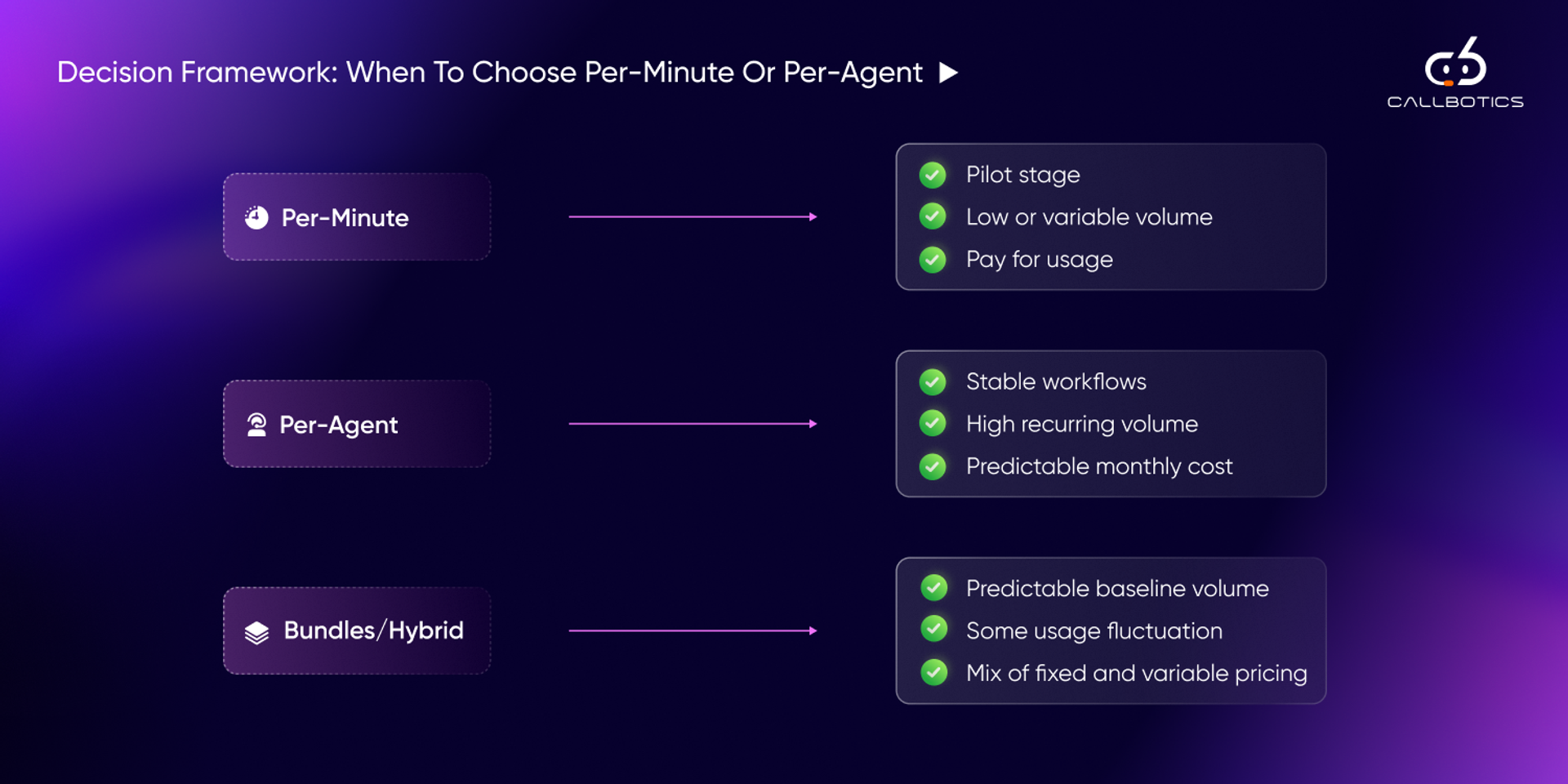
Per-minute pricing is often the better fit for early-stage pilots, narrow workflows, and inconsistent demand. If the business wants flexibility and does not yet know what usage will look like, paying for consumption directly can make sense.
Per-agent pricing is often stronger for teams with steady workflows, predictable usage, and a desire for more forecastable costs as automation expands. It can be especially useful when one deployed agent supports a high-volume, recurring workflow.
Bundles and hybrid models often work well when buyers want some predictability without giving up usage alignment entirely. They can offer a middle ground between volatility and fixed-capacity commitment.
By the time pricing reaches procurement, many of the most important questions should already be on the table. This section helps buyers focus on the contract details that actually affect long-term cost and operational flexibility. The goal is not just to negotiate price, but to negotiate clarity.
Make vendors define what counts as a minute, how silence is treated, how rounding works, and whether billing is based on call duration, audio duration, or channels.
Ask for a written list of what the platform fee includes and what it does not. This should cover integrations, analytics, support, reporting, workflow tools, and compliance controls.
Support quality matters in production. Buyers should require clarity on uptime, response times, onboarding support, managed services, and the support level included in the quoted price.
Where relevant, buyers should ask whether they can bring their own model keys, telephony, or infrastructure, or whether the vendor can commit to transparent pass-through pricing without hidden markup.
CallBotics approaches pricing through an operational lens. Developed by teams with over 18 years of contact center operator experience, the platform is built by people who understand how pricing models behave in real-world conditions, including volume spikes, seasonal surges, changing call patterns, and scaling pressure. Instead of focusing solely on headline rates, the discussion centers on workflow fit, expected demand, integration needs, and what the business is actually trying to automate. That gives teams a clearer view of whether the pricing structure supports real execution, predictable scaling, and stronger resolution economics over time.
What CallBotics helps teams evaluate clearly:
Per-minute and per-agent pricing are not just different billing formats. They create different cost structures, different operational incentives, and different scaling dynamics. One model may be more elastic and pilot-friendly. The other may be more predictable and better suited to stable, high-volume automation. Neither is automatically right without context.
The best choice depends on volume patterns, workflow design, deployment maturity, and how closely the pricing structure aligns with real business outcomes. The most reliable way to compare vendors is to look past the headline rate, expose the hidden cost layers, and evaluate how the model behaves under real monthly operating conditions.
If you are evaluating voice AI pricing, compare vendors based on workflow fit, deployment needs, and resolution economics, not just the top-line number on the quote.

Urza Dey (She/They) is a content/copywriter who has been working in the industry for over 5 years now. They have strategized content for multiple brands in marketing, B2B SaaS, HealthTech, EdTech, and more. They like reading, metal music, watching horror films, and talking about magical occult practices.
See how enterprises automate calls, reduce handle time, and improve CX with CallBotics.
CallBotics is an enterprise-ready conversational AI platform, built on 18+ years of contact center leadership experience and designed to deliver structured resolution, stronger customer experience, and measurable performance.