
Schedule adherence is one of the most important workforce management metrics in modern contact centers. It measures how closely agents follow their assigned schedules, including shift start times, break periods, training blocks, and availability to handle customer interactions.
When schedule adherence is strong, contact centers maintain predictable staffing levels and stable service performance. When adherence drops, queues grow longer, response times slow down, and operational pressure increases across teams.
For operations leaders, schedule adherence sits at the intersection of staffing efficiency, workforce discipline, and customer experience. Too little adherence creates operational instability, while overly strict enforcement can lead to agent burnout.
Modern contact centers are also increasingly using automation and AI-driven workflow systems to stabilize operations and reduce pressure on human agents. Platforms like CallBotics help teams manage high-volume interactions more efficiently while improving staffing predictability.
This guide explains what schedule adherence means in a call center, how it is calculated, what factors influence it, and how teams can improve adherence while maintaining a healthy working environment.
Schedule adherence measures the percentage of time agents follow their assigned schedules.
This includes:
In practice, schedule adherence reflects how closely actual agent activity matches the planned workforce schedule created by the workforce management team.
Because contact centers rely heavily on precise staffing forecasts, even small deviations in agent availability can affect service levels.
Schedule adherence is often confused with other workforce management metrics.
Here is the key difference:
| Metric | What It Measures |
|---|---|
| Schedule Adherence | Whether agents perform the correct activity at the correct scheduled time |
| Schedule Conformance | Total time worked compared with total scheduled time |
| Schedule Attainment | Whether scheduled activities were completed during the shift |
Adherence focuses on timing accuracy, while conformance focuses on total work hours.
Understanding the difference helps workforce managers evaluate operational performance more accurately.
Most contact centers set adherence targets within a realistic range rather than aiming for perfect compliance.
Typical targets fall between 85 percent and 95 percent, depending on operational complexity.
Targets vary based on:
Setting realistic targets ensures adherence to expectations that reflect operational reality rather than ideal conditions.
Understanding how schedule adherence is calculated helps operations teams monitor workforce performance more effectively.
The basic schedule adherence formula compares the actual time spent on scheduled tasks to the total scheduled time.
Schedule Adherence (%) = (Scheduled Time − Non-Adherent Time) ÷ Scheduled Time × 100
Example:
Scheduled shift: 480 minutes Out-of-schedule time: 30 minutes
Adherence = (480 − 30) ÷ 480 × 100 Adherence = 93.75 percent
This percentage represents how closely an agent followed their assigned schedule.
Schedule adherence can be measured at multiple levels.
Agent-level adherence tracks individual performance and identifies coaching opportunities.
Contact center adherence measures overall workforce discipline across teams and shifts.
Center-level adherence helps workforce planners understand how staffing behavior affects operational performance.
While percentages provide a quick overview, workforce managers also analyze time variance.
Variance measures the actual number of minutes agents deviate from their schedules.
For example:
Agent A adherence: 92 percent Agent B adherence: 92 percent
However:
Agent A variance: 10 minutes Agent B variance: 45 minutes
Both agents show the same adherence percentage, but the operational impact differs significantly.
Shrinkage refers to the time agents are unavailable for handling customer interactions due to planned or unplanned events.
Common shrinkage categories include:
When analyzing adherence at scale, workforce planners must account for shrinkage to avoid misinterpreting workforce behavior.
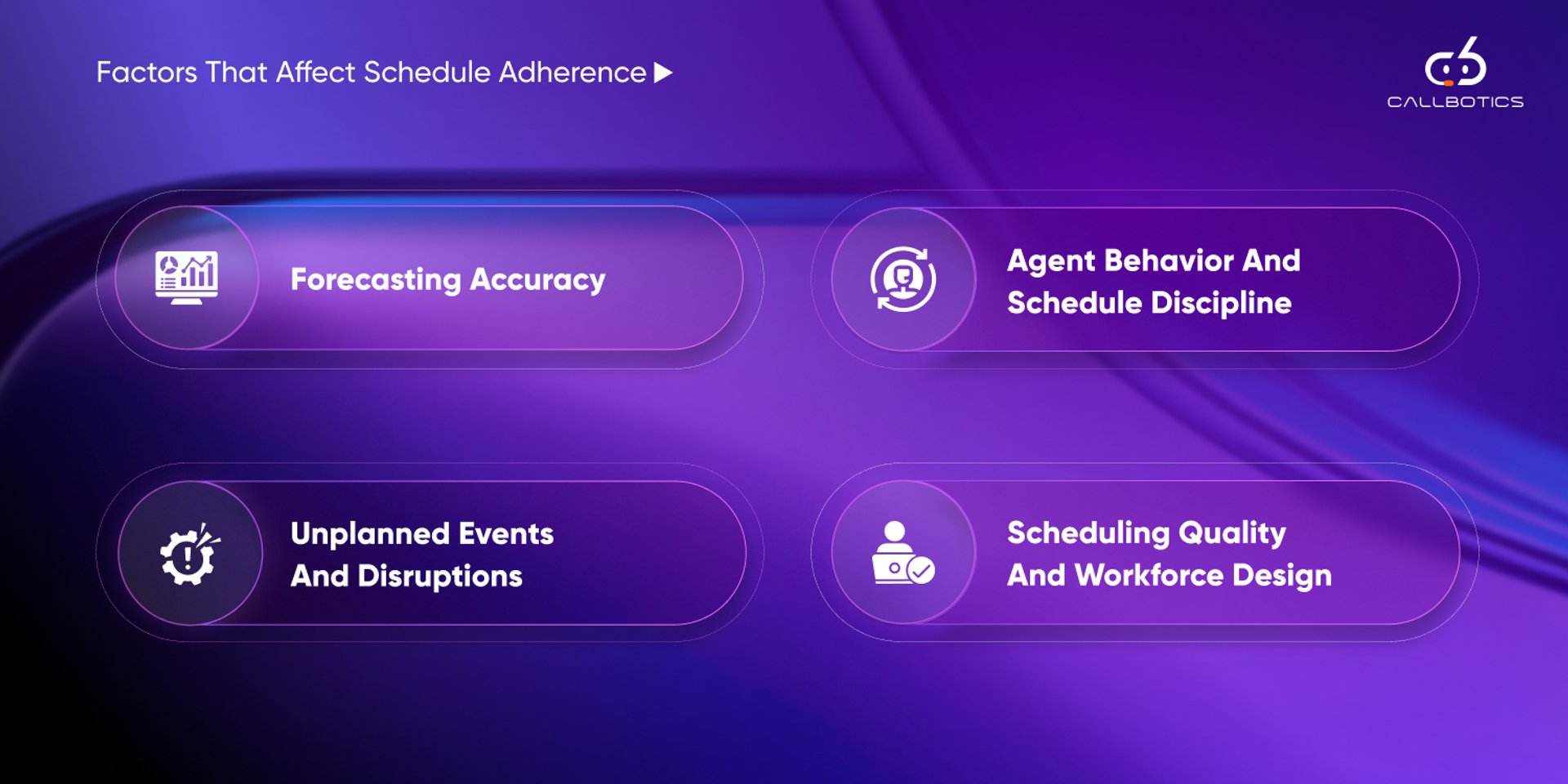
Several operational factors influence adherence performance.
Accurate forecasting allows workforce managers to schedule the right number of agents at the right times.
Poor forecasts create staffing imbalances that make adherence harder to maintain.
For example, if call volume suddenly spikes, agents may delay breaks or remain in calls longer than scheduled.
Unexpected disruptions can reduce adherence quickly.
Examples include:
Operational resilience requires contingency planning to absorb these disruptions.
Individual behavior also plays a role.
Common adherence issues include:
Clear expectations and coaching help address these behaviors.
Even highly disciplined agents struggle to maintain adherence if schedules are poorly designed.
Weak schedules may include:
Effective workforce design improves adherence naturally.
Industries such as healthcare contact centers often experience sudden spikes in call volume related to patient inquiries, appointment requests, and urgent care coordination. Maintaining strong schedule adherence in these environments requires careful workforce planning and operational flexibility.
Schedule adherence is closely tied to workforce productivity and service performance.
Higher adherence improves staffing predictability.
When agents are available at the expected times, workforce managers can align staffing with demand more accurately.
This reduces idle time and prevents unnecessary overtime.
Poor adherence reduces available staffing during critical demand periods.
This leads to:
Strong adherence helps maintain service levels and customer satisfaction.
Adherence alone does not guarantee healthy workforce performance.
If adherence targets are enforced without considering occupancy levels, agents may experience excessive workload pressure.
Balanced workforce strategies consider both adherence and workload intensity.
Retail and e-commerce support teams often experience large fluctuations in call volume during promotions, product launches, or holiday seasons. Maintaining schedule adherence in retail contact centers helps ensure enough agents are available during peak demand periods.
Agent adherence works closely with other efficiency metrics, such as Average Handle Time (AHT), which measures how long agents spend resolving interactions and how effectively staffing capacity is used.
Healthy schedule adherence starts long before agents log in for their shifts. It begins with thoughtful workforce planning, accurate forecasting, and schedules that reflect how contact center operations actually function during the day.
When schedules are designed realistically, agents can follow them without constant friction. When schedules are unrealistic or misaligned with demand, adherence issues appear quickly.
Strong workforce management teams treat scheduling as a strategic activity that balances demand patterns, agent availability, and operational flexibility.
Skill-based scheduling ensures the right agents are available when specific types of interactions are most likely to occur.
Contact centers rarely handle a single type of request. Calls may include billing inquiries, technical support issues, product questions, or account management requests. Each of these requires different levels of expertise.
By aligning agent skill sets with predicted demand patterns, organizations can improve both coverage and operational efficiency.
Skill-based scheduling helps:
This approach improves staffing precision and allows workforce managers to distribute workloads more effectively across teams.
Schedules that assume perfect adherence often fail in real-world operations. Contact center environments are dynamic, and agents regularly encounter situations that extend beyond their scheduled activity blocks.
For example:
Including buffer time between scheduled activities helps absorb these small disruptions without creating cascading adherence problems throughout the shift.
Realistic break scheduling also supports agent well-being. When agents know they will have predictable opportunities to rest and reset, they are more likely to maintain focus and performance throughout their shifts.
Demand patterns in contact centers rarely remain constant throughout the day. Interaction volumes typically rise during certain hours and decline during others.
Strategically staggering shifts and breaks allows workforce managers to distribute staffing coverage more evenly across these demand peaks.
Instead of large groups of agents starting or stopping work at the same time, staggered scheduling ensures that coverage remains consistent throughout the day.
Benefits include:
This approach helps maintain operational stability while still providing agents with predictable schedules.
Even the best forecasts cannot anticipate every disruption.
Unexpected events such as sudden call spikes, absenteeism, system outages, or external incidents can quickly affect staffing availability.
Maintaining flexible reserve coverage helps absorb these operational shocks.
Reserve coverage may include:
Having flexible staffing capacity allows contact centers to maintain service levels without placing excessive pressure on the existing workforce.
Even with strong schedules in place, daily operational management plays a major role in maintaining schedule adherence.
Contact center leaders rely on a combination of monitoring tools, coaching practices, and workforce management systems to identify adherence gaps and respond quickly.
Real-time visibility allows supervisors to identify schedule deviations as they happen rather than discovering them later in reports.
Modern workforce dashboards provide live updates on agent activity statuses, including:
Automated alerts can notify supervisors when agents move outside their scheduled activity windows.
Early intervention helps teams correct issues quickly before they escalate into broader staffing problems.
For example, if an agent remains in break status longer than scheduled, a supervisor can address the situation immediately rather than allowing the deviation to affect the rest of the shift.
Workforce management platforms have evolved significantly in recent years. Many modern systems now incorporate AI-powered forecasting and scheduling capabilities.
These tools analyze historical interaction data, seasonal trends, and operational patterns to generate more accurate staffing forecasts.
AI scheduling systems help workforce managers:
By improving forecasting accuracy, these systems reduce the likelihood of schedule deviations caused by staffing mismatches.
While technology supports adherence monitoring, human engagement remains equally important.
Agents are more likely to follow schedules consistently when they understand how their availability affects the broader operation.
Coaching programs can reinforce this connection by explaining how adherence influences:
Managers should also work with agents to identify barriers that make adherence difficult, such as system inefficiencies or unrealistic break timing.
When agents feel supported rather than monitored, adherence typically improves naturally.
Workforce discipline improves when adherence is embedded in the organization's performance culture.
Recognition programs can reinforce positive behaviors and encourage consistent schedule discipline.
Examples include:
A culture of fairness and transparency is critical. When adherence expectations are clear and consistently applied, agents are more likely to take ownership of their schedules.
Legal service organizations also rely heavily on predictable phone support, especially for client intake, consultation scheduling, and case updates. Maintaining adherence ensures legal support teams can respond quickly to time-sensitive inquiries.
Schedule adherence should not be treated as a static performance score. Instead, it should be analyzed as part of a continuous operational improvement process.
Regular reporting helps contact centers identify patterns that may not be visible in day-to-day operations.
Analyzing adherence data across multiple dimensions helps workforce managers uncover recurring issues.
For example, analysis may reveal that:
Identifying these patterns allows organizations to address structural scheduling issues rather than focusing only on individual performance.
Schedule adherence should always be evaluated alongside customer experience metrics.
Looking at adherence alone may hide important operational trade-offs.
Combining adherence with metrics such as:
Provides a more balanced view of workforce effectiveness.
For example, extremely high adherence combined with declining CSAT may indicate that agents are under excessive pressure.
Operational conditions evolve constantly in contact centers.
New products, seasonal demand changes, and new communication channels can all affect staffing requirements.
For this reason, adherence targets should be reviewed periodically rather than treated as permanent benchmarks.
Recalibration ensures targets remain aligned with:
Continuous optimization helps maintain both operational efficiency and agent satisfaction.
While schedule adherence is primarily a workforce management metric, its ultimate impact is felt by customers.
Stable staffing levels lead to more consistent and predictable service experiences.
When agents follow schedules closely, workforce planners can rely on staffing forecasts to match demand.
This results in:
Customers benefit from quicker access to support and faster issue resolution.
Predictable staffing coverage is especially important during high-demand periods.
When adherence is strong, contact centers maintain adequate agent availability during peak hours.
This prevents queues from growing too long and reduces the likelihood of repeated contact attempts from frustrated customers.
Balanced schedules and realistic adherence expectations also contribute to agent well-being.
When agents are not overwhelmed by unpredictable workloads or excessive monitoring pressure, they are more likely to deliver calm, effective customer interactions.
Stable teams typically produce better customer experiences and stronger long-term loyalty.
Insurance service teams frequently manage complex interactions such as claims inquiries and policy updates. Maintaining predictable staffing coverage is critical for insurance contact centers that must balance high call volumes with regulatory and service-level expectations.
Schedule adherence should always be evaluated alongside other operational metrics. For example, Average Speed of Answer helps teams understand how staffing availability affects customer wait times and service responsiveness. Other operational metrics help provide context for workforce performance.
Average Speed of Answer (ASA) measures how quickly customer interactions are answered.
Average Handle Time (AHT) measures how long agents spend resolving interactions.
Together, these metrics help reveal how adherence affects customer-facing performance.
Occupancy measures the proportion of time agents spend actively handling interactions.
High adherence combined with extremely high occupancy can signal agent overwork and potential burnout risk.
Monitoring these metrics together helps maintain workforce balance.
Shrinkage represents the percentage of scheduled time agents are unavailable due to planned or unplanned activities.
Variance measures the difference between scheduled and actual activity time.
Analyzing shrinkage and variance helps workforce managers identify the root causes of adherence gaps and refine scheduling strategies accordingly.
Improving adherence requires a structured operational approach.
Begin by calculating current adherence performance.
Identify the largest sources of deviation.
Immediate improvements may include:
Deploy workforce management tools and analytics dashboards.
Automation improves forecasting and scheduling accuracy.
Long-term improvement requires ongoing coaching and performance monitoring.
Targets should be reviewed regularly.
Adherence should support service performance rather than replace it as the primary operational goal.
Unrealistic adherence targets create frustration and weaken workforce trust.
Targets should reflect real operational conditions.
Coaching and positive reinforcement typically improve adherence more effectively than disciplinary approaches alone.
Many schedule adherence challenges do not come from agent discipline alone. They often stem from operational complexity, unpredictable call volumes, inefficient workflows, and limited visibility into what is happening inside live interactions.
When queues spike unexpectedly or repetitive calls consume large portions of agent capacity, even well-designed schedules can quickly fall out of alignment. Improving adherence, therefore, requires more than stricter monitoring. It requires stabilizing the operational environment that agents work within.
CallBotics approaches this challenge by combining AI voice automation with deep operational analytics. Instead of focusing only on handling individual calls, the platform helps contact centers reduce workload volatility and improve staffing predictability.
By automating repetitive interactions and providing real-time operational insights, CallBotics enables support teams to maintain stable staffing coverage even during unpredictable demand.
After automation is deployed, contact centers often experience smoother call distribution, fewer unexpected queue spikes, and better alignment between workforce schedules and real demand patterns.
By reducing call-volume volatility and improving operational visibility, CallBotics helps contact centers create a more stable environment in which workforce schedules operate as intended.
This allows teams to improve schedule adherence while maintaining a healthy balance between staffing efficiency, agent workload, and customer experience.
Schedule adherence is a foundational workforce management metric in modern contact centers.
It measures how closely agents follow their assigned schedules and directly influences staffing stability, response speed, and customer experience.
Improving adherence requires a balanced approach that includes accurate forecasting, realistic scheduling, operational visibility, and supportive workforce management practices.
When combined with automation, analytics, and strong leadership, schedule adherence becomes a powerful lever for improving both operational efficiency and customer outcomes.

Urza Dey (She/They) is a content/copywriter who has been working in the industry for over 5 years now. They have strategized content for multiple brands in marketing, B2B SaaS, HealthTech, EdTech, and more. They like reading, metal music, watching horror films, and talking about magical occult practices.
See how enterprises automate calls, reduce handle time, and improve CX with CallBotics.
CallBotics is an enterprise-ready conversational AI platform, built on 18+ years of contact center leadership experience and designed to deliver structured resolution, stronger customer experience, and measurable performance.