When companies evaluate enterprise AI platforms, pricing is often one of the first questions buyers try to answer. However, with many AI vendors moving toward custom enterprise contracts, finding clear pricing information can be difficult.
This is especially true for Sierra AI. While the platform has gained attention for its AI agents and automation capabilities, its pricing structure is not publicly published in traditional SaaS-style tiers.
For buyers evaluating conversational AI platforms, understanding the Sierra AI pricing model, expected costs, and implementation factors is critical before requesting a quote.
Businesses exploring conversational automation platforms often compare vendors based on pricing transparency, deployment complexity, and operational fit. Platforms like CallBotics focus specifically on voice-first automation for contact center workflows, making pricing comparisons easier for teams evaluating AI voice agents.
This guide breaks down what is known about Sierra AI pricing in 2026, including how enterprise pricing typically works, the factors that influence cost, and how Sierra compares with alternatives such as CallBotics for AI voice automation.
Sierra AI is an enterprise conversational AI platform designed to automate customer interactions using AI agents capable of completing tasks across multiple systems.
Rather than functioning as a simple chatbot, Sierra AI focuses on AI agents that execute workflows such as:
The platform was founded by technology leaders Bret Taylor and Clay Bavor and targets large organizations with high customer interaction volumes.
Typical industries using Sierra AI include:
Because these organizations often manage millions of customer interactions, they require automation systems capable of executing complex workflows rather than simply answering questions.
Sierra positions itself as a customer experience automation platform rather than a basic conversational AI tool.
Conversational AI platforms like Sierra are often used in industries such as healthcare, where organizations handle large volumes of appointment scheduling, patient support inquiries, and service coordination.
One of the most common questions buyers ask when researching enterprise AI platforms is whether pricing is available publicly. Transparent pricing allows organizations to quickly estimate budget requirements and compare multiple vendors without entering a lengthy sales process.
In the case of Sierra AI, pricing information is not publicly listed on the company’s website. Instead, most deployments follow a custom enterprise quote model, where pricing is provided after an initial discovery process with the vendor’s sales and technical teams.
This approach is common among enterprise AI platforms, particularly those designed for large-scale customer support operations. Because deployments often involve complex integrations, workflow customization, and compliance considerations, vendors typically avoid fixed pricing tiers.
As a result, organizations evaluating Sierra AI should expect to go through several steps before receiving a pricing estimate, including:
While this process allows vendors to tailor pricing to each organization’s needs, it also means that buyers may need to invest more time before they can compare Sierra AI’s cost with competing platforms.
Enterprise software vendors often avoid publishing fixed-price plans because deployments can vary significantly across customers.
While enterprise buyers typically evaluate conversational AI platforms through structured vendor assessments, including security reviews, architecture validation, and operational pilot testing, before pricing negotiations begin.
Two organizations using the same conversational AI platform may require completely different levels of infrastructure, customization, and support. For example, a company automating a simple FAQ workflow will have very different requirements compared to a global enterprise automating multiple customer service processes.
Several variables influence pricing in enterprise AI deployments, including:
Because of this variability, many vendors prefer a custom quote model that allows them to evaluate the scope of the deployment before determining pricing.
However, the downside of this model is that buyers often cannot estimate costs until after engaging directly with the vendor’s sales team. This can make early-stage comparisons between platforms more difficult.
Organizations researching Sierra AI should therefore plan to gather detailed operational information before requesting a pricing estimate.
Before entering a vendor evaluation process, organizations should prepare key information that will help vendors generate accurate pricing estimates.
Providing detailed inputs allows companies to receive more meaningful quotes and compare platforms more effectively.
Important inputs include:
Clarifying these factors early helps vendors understand the scale of the deployment and prevents unexpected pricing changes later in the process.
Well-prepared organizations also find it easier to compare pricing between different conversational AI platforms because the scope of the evaluation remains consistent.
Even though Sierra AI does not publicly disclose exact pricing plans, most enterprise conversational AI platforms follow a similar pricing framework.
Understanding these components helps buyers estimate the total cost of ownership and avoid surprises during the procurement process.
Enterprise conversational AI pricing typically includes a combination of platform licensing, usage-based costs, implementation services, and ongoing support fees.
Most enterprise AI platforms charge a base subscription or platform license fee.
This fee typically grants access to the core infrastructure required to run AI agents, including:
Platform license fees are usually billed annually and may represent a significant portion of enterprise contracts.
In some cases, the license fee also includes a limited number of interactions or workflows, with additional usage billed separately.
For organizations deploying conversational AI across multiple teams, the platform license provides the foundational infrastructure that supports automation at scale.
In addition to base platform fees, many AI vendors include variable pricing based on usage.
Usage may be measured in several ways, depending on the platform architecture. Common billing metrics include:
Because these usage metrics scale with interaction volume, costs can increase as automation expands across departments or channels.
Organizations planning large-scale automation should therefore estimate expected interaction volumes carefully to understand long-term pricing implications.
Another important component of enterprise conversational AI pricing is implementation.
Unlike simple SaaS tools, enterprise AI deployments often require extensive configuration and integration work before the system becomes operational.
Implementation services may include:
These services are often billed as professional services and may be charged as one-time fees during the initial deployment phase.
For complex deployments, implementation costs can represent a substantial portion of the first-year investment.
Platforms using AI voice analytics help teams understand how automated conversations perform and identify areas where workflows require improvement.
Enterprise customers often require higher levels of operational support compared to smaller SaaS deployments.
To address this, vendors may offer multiple support tiers with different service levels.
These may include:
Organizations requiring higher reliability or faster support response times may see higher pricing due to these service tiers.
These support services are particularly important for mission-critical automation systems that directly affect customer experience.
Even within the enterprise pricing model, several variables strongly influence the final cost of a Sierra AI deployment.
Understanding these factors helps buyers estimate potential pricing ranges before requesting a formal quote.
The complexity of automated workflows is one of the largest drivers of conversational AI pricing.
Simple automation use cases typically involve straightforward interactions such as:
These workflows require minimal decision logic and fewer system integrations.
In contrast, more advanced workflows may involve multi-step processes such as:
Complex workflows require more sophisticated automation logic and integration capabilities, which can increase both development effort and pricing.
Insurance providers often rely on conversational AI to automate workflows such as claims inquiries, policy updates, and coverage questions, making automation particularly valuable in insurance contact center environments.
Organizations exploring conversational automation often start by learning how to automate IVR with voice AI agents before expanding automation across broader customer support workflows.
Most conversational AI deployments require integration with existing business systems.
These integrations allow AI agents to retrieve information and perform actions on behalf of customers.
Common integrations include:
Custom integrations can significantly increase project scope because they often require API development, data mapping, and security validation.
The more backend systems involved in a workflow, the greater the implementation complexity and cost.
Another major pricing factor is interaction volume.
Organizations handling large numbers of customer interactions may require infrastructure capable of supporting:
High concurrency requirements often require more powerful infrastructure and advanced orchestration capabilities.
As a result, platforms supporting large-scale deployments may charge higher usage fees to maintain performance and reliability.
Retail and e-commerce brands often experience extreme fluctuations in interaction volume during product launches, promotions, and holiday seasons, making automation valuable for retail and e-commerce customer support teams.
Large enterprises frequently operate under strict regulatory and security requirements.
Examples include:
Meeting these requirements often requires additional infrastructure configuration and operational safeguards.
These additional controls can increase both implementation complexity and ongoing operational costs.
When evaluating enterprise AI platforms, many organizations focus primarily on the quoted platform price.
However, the total cost of ownership often includes additional operational costs that may not appear in initial pricing estimates.
Enterprise AI deployments typically require collaboration between multiple internal teams.
These teams may include:
The time and effort required from internal teams can significantly increase the overall investment required to launch a conversational AI system.
AI agents rarely achieve optimal performance immediately after deployment.
To maintain accuracy and reliability, organizations must continuously monitor and improve automation performance.
Typical optimization activities include:
These ongoing improvements require operational resources and should be considered when estimating long-term costs.
Many organizations begin automation in a single department before expanding to additional teams.
For example:
Each expansion phase may require additional licenses, integrations, or infrastructure capacity.
As automation grows across the organization, the total cost of ownership may increase significantly.
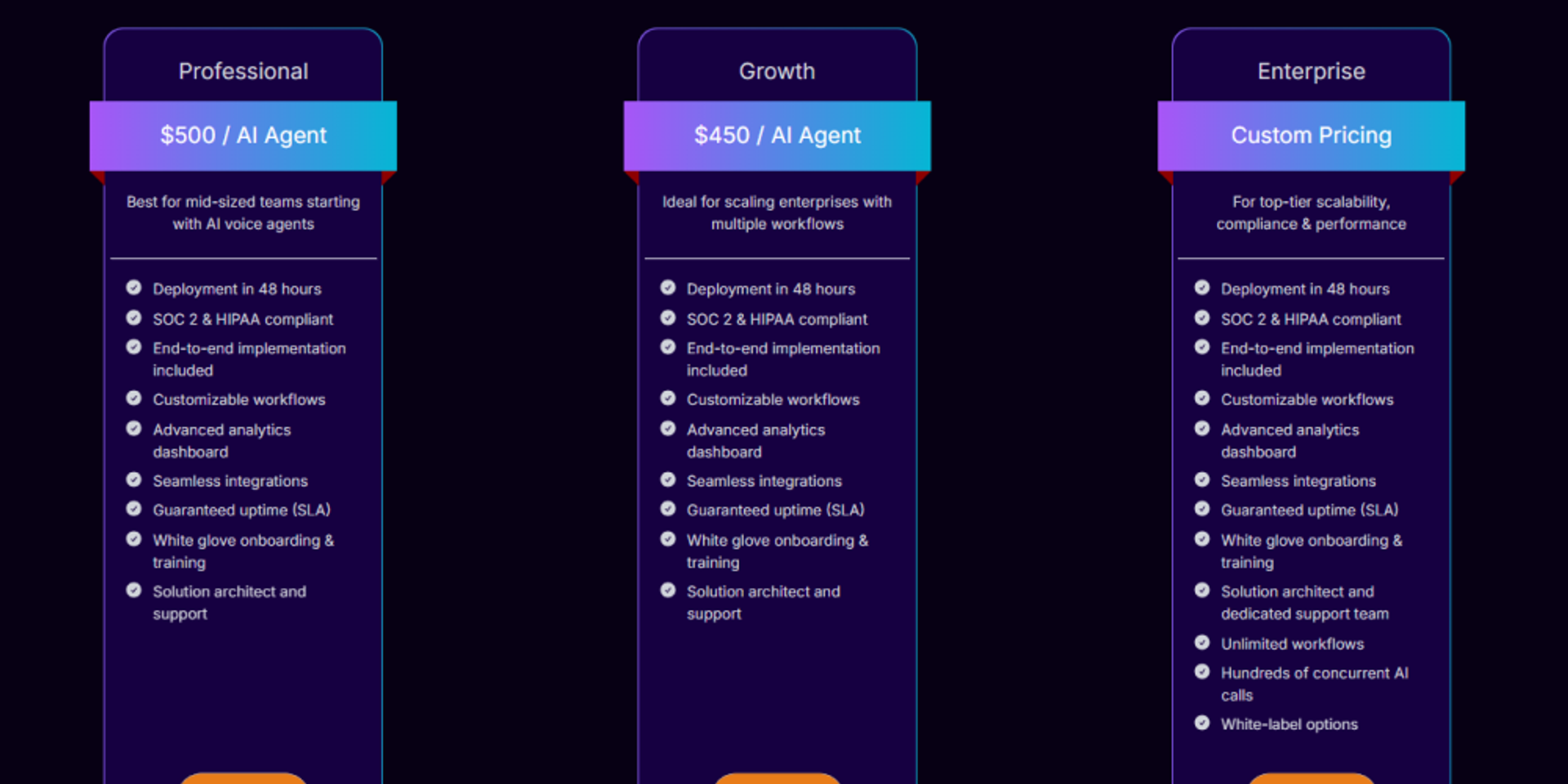
Caption: CallBotics’ AI voice agent pricing tiers showing professional, growth, and enterprise plans with different automation capabilities and scalability levels.
Unlike many enterprise conversational AI platforms that rely heavily on custom pricing negotiations, CallBotics focuses on predictable pricing aligned with automation scope and call volume, helping organizations estimate ROI earlier in the evaluation process.
The platform focuses on AI voice agents that automate inbound calls, resolve customer issues, and provide operational visibility across voice interactions.
CallBotics pricing is typically structured around automation scope and interaction volume.
Instead of requiring extensive enterprise discovery before providing cost estimates, pricing is often easier to estimate earlier in the evaluation process.
This allows teams to evaluate:
More quickly during vendor comparison.
Another key difference lies in the implementation approach.
Many enterprise conversational AI platforms require multi-week integration cycles before automation becomes operational.
CallBotics focuses on rapid deployment for defined workflows, allowing AI voice agents to go live much faster in many environments.
This faster deployment allows organizations to begin measuring automation outcomes earlier in the adoption process.
When evaluating pricing, organizations should compare not only the platform cost but also the operational impact.
Sierra AI typically uses a custom enterprise pricing model that requires sales engagement before cost estimates are provided.
CallBotics provides earlier visibility into pricing structure, making budgeting and evaluation easier during the evaluation phase.
Enterprise AI deployments often take weeks or months to become operational.
CallBotics emphasizes faster time-to-value through workflow-driven implementation and rapid deployment of voice automation. Defined workflows can typically be deployed in as little as 48 hours, allowing teams to begin testing and iterating on automation quickly.
This shorter implementation cycle can be an important factor for contact centers that need to automate high-volume call workflows without long deployment timelines.
Sierra AI is often used for digital support automation across chat and messaging channels.
CallBotics is designed specifically for voice-driven service environments where contact centers handle large volumes of inbound calls. The platform enables organizations to automate routine service requests, improve first-call resolution, and maintain operational visibility across automated interactions.
AI voice agents can automatically resolve routine calls, allowing teams to focus on more complex customer needs. In many contact center environments, automation can achieve up to approximately 80% containment for repetitive workflows, depending on the use case and call type.
Businesses with heavy inbound call volumes may prioritize platforms designed specifically for voice interactions.
Understanding the difference between traditional IVR systems and AI-driven automation is critical when evaluating platforms. Our guide on IVR vs AI voice agents explains how conversational AI improves resolution and routing accuracy.
As conversational AI expands across teams and channels, operational complexity can increase.
Costs may grow due to:
Organizations should evaluate long-term scalability alongside initial pricing.
The answer depends heavily on an organization’s size, automation needs, and operational complexity.
Sierra AI may be a strong fit for organizations that:
In these environments, advanced automation capabilities can generate significant efficiency gains.
CallBotics may be a better fit when organizations:
Organizations evaluating AI automation should compare both technology capabilities and operational alignment.
Before committing to any enterprise AI platform, buyers should ask detailed questions about pricing, implementation, and performance.
These questions help organizations evaluate total cost and operational fit.
Sierra AI is positioned as a powerful enterprise conversational AI platform capable of automating complex customer interactions.
However, its pricing model follows a typical enterprise structure, meaning costs are not publicly published and depend on each organization’s deployment scope.
Buyers evaluating Sierra AI should consider more than the quoted platform price. Implementation complexity, integration requirements, and long-term operational costs all influence the total investment.
Comparing alternatives such as CallBotics can help organizations determine which platform best fits their automation goals, deployment timelines, and operational environment.
Organizations comparing multiple platforms may also review our guide to the best conversational AI platforms for enterprise operations before finalizing their vendor evaluation.
Ultimately, the best choice depends on aligning AI technology with real business workflows and customer interaction patterns.

Urza Dey (She/They) is a content/copywriter who has been working in the industry for over 5 years now. They have strategized content for multiple brands in marketing, B2B SaaS, HealthTech, EdTech, and more. They like reading, metal music, watching horror films, and talking about magical occult practices.
See how enterprises automate calls, reduce handle time, and improve CX with CallBotics.
CallBotics is an enterprise-ready conversational AI platform, built on 18+ years of contact center leadership experience and designed to deliver structured resolution, stronger customer experience, and measurable performance.