Businesses today rarely let incoming calls go unanswered. Whether the goal is capturing leads, assisting customers, or managing appointments, companies rely on call-handling solutions to ensure every interaction is addressed quickly and professionally.
Two common approaches dominate this space: virtual receptionists and automated answering services.
At first glance, both seem to solve the same problem. They answer incoming calls and ensure the caller reaches the right destination. But the way they operate, the level of interaction they provide, and the impact they have on business operations are very different.
Choosing the right approach can affect customer satisfaction, operational efficiency, and the scalability of your support operations.
The growing demand for call-handling solutions reflects this importance. The live virtual receptionist service market was valued at roughly USD 1.64 billion in 2025 and is projected to reach around USD 3.42 billion by 2033, highlighting how businesses are investing in better ways to manage customer interactions.
At the same time, automation technologies are transforming how companies handle inbound calls. According to research from McKinsey, organizations are increasingly exploring the right balance between human expertise and AI-driven automation when designing the contact centers of the future.
This guide explores the differences between virtual receptionists and automated answering services, their advantages, limitations, and how to determine which approach works best for your business.
A virtual receptionist is a service that answers calls for your business without requiring an in-house receptionist.
Traditionally, this service is provided by remote agents who greet callers, collect information, and route calls to the correct department. In many modern implementations, virtual receptionists may also be supported by AI voice technology that handles routine interactions.
Common tasks handled by virtual receptionists include:
Unlike simple call routing systems, a virtual receptionist interacts conversationally with callers. This allows the service to understand requests, ask clarifying questions, and provide a more natural experience.
For businesses that depend on inbound phone leads or customer interactions, this conversational capability can significantly improve caller satisfaction.
Want to see how conversational AI can act as a modern receptionist for inbound calls? Explore how CallBotics AI voice agents handle conversations, capture details, and route calls intelligently.
An automated answering service uses technology rather than human interaction to manage incoming calls.
Most automated answering systems rely on menu-based navigation, commonly known as IVR (interactive voice response). Callers hear pre-recorded prompts and select options using keypad input or voice commands.
Typical automated answering features include:
For example, a caller might hear:
“Press 1 for billing. Press 2 for support.”
These systems are designed primarily for routing rather than conversation.
Automated answering services work well for organizations with predictable call flows and high volumes of simple inquiries.
If you want to explore how automation differs from conversational voice systems, see IVR vs AI voice agents.
Understanding the difference between a virtual receptionist and an automated answering service becomes clearer when comparing how calls are handled in real situations.
Automated answering services are typically designed to route calls.
They move callers through menu trees until they reach the correct department or voicemail inbox.
Virtual receptionists go a step further. Instead of only routing calls, they can:
This allows businesses to handle more inbound interactions without requiring a live agent.
Caller experience differs significantly between the two options.
Automated answering services require callers to navigate menu trees. This works well when call reasons are predictable, but can create frustration when callers cannot find the right option.
Virtual receptionists offer conversational interactions. Callers can explain their request naturally, and the receptionist determines the appropriate action.
This conversational approach often feels more personal and reduces caller confusion.
Both options improve availability compared to relying solely on internal staff.
Automated answering systems provide continuous coverage because they operate without human involvement.
Virtual receptionist services also extend coverage, especially when supported by AI or hybrid staffing models.
This allows businesses to remain responsive outside regular business hours without increasing staffing costs.
Automated answering services rely on structured menu trees.
When departments change or call flows evolve, administrators must update prompts and routing logic manually.
Virtual receptionist services rely more on conversational handling and flexible scripts. This makes it easier to adapt call handling as business needs evolve.
However, both approaches require periodic updates to maintain accuracy.
Another important difference between a virtual receptionist and an automated answering service involves system integrations.
Modern receptionist platforms can connect to:
These integrations allow receptionists to perform real actions during calls rather than simply routing them. Businesses looking to modernize call handling often combine automation with conversational AI.
Learn how CallBotics AI voice agents integrate with CRM and scheduling systems to handle inbound calls more intelligently.
| Feature | Virtual receptionist | Automated answering service |
|---|---|---|
| Interaction style | Conversational | Menu-based |
| Call handling | Can capture information and complete tasks | Primarily routes calls |
| Availability | Often extended hours or AI-assisted coverage | Always available |
| Setup complexity | Moderate | Low |
| Integrations | CRM, scheduling, databases | Limited |
| Best use cases | Lead capture, appointments, and customer inquiries | Department routing, voicemail |
Both options solve call coverage challenges, but they address different operational needs.
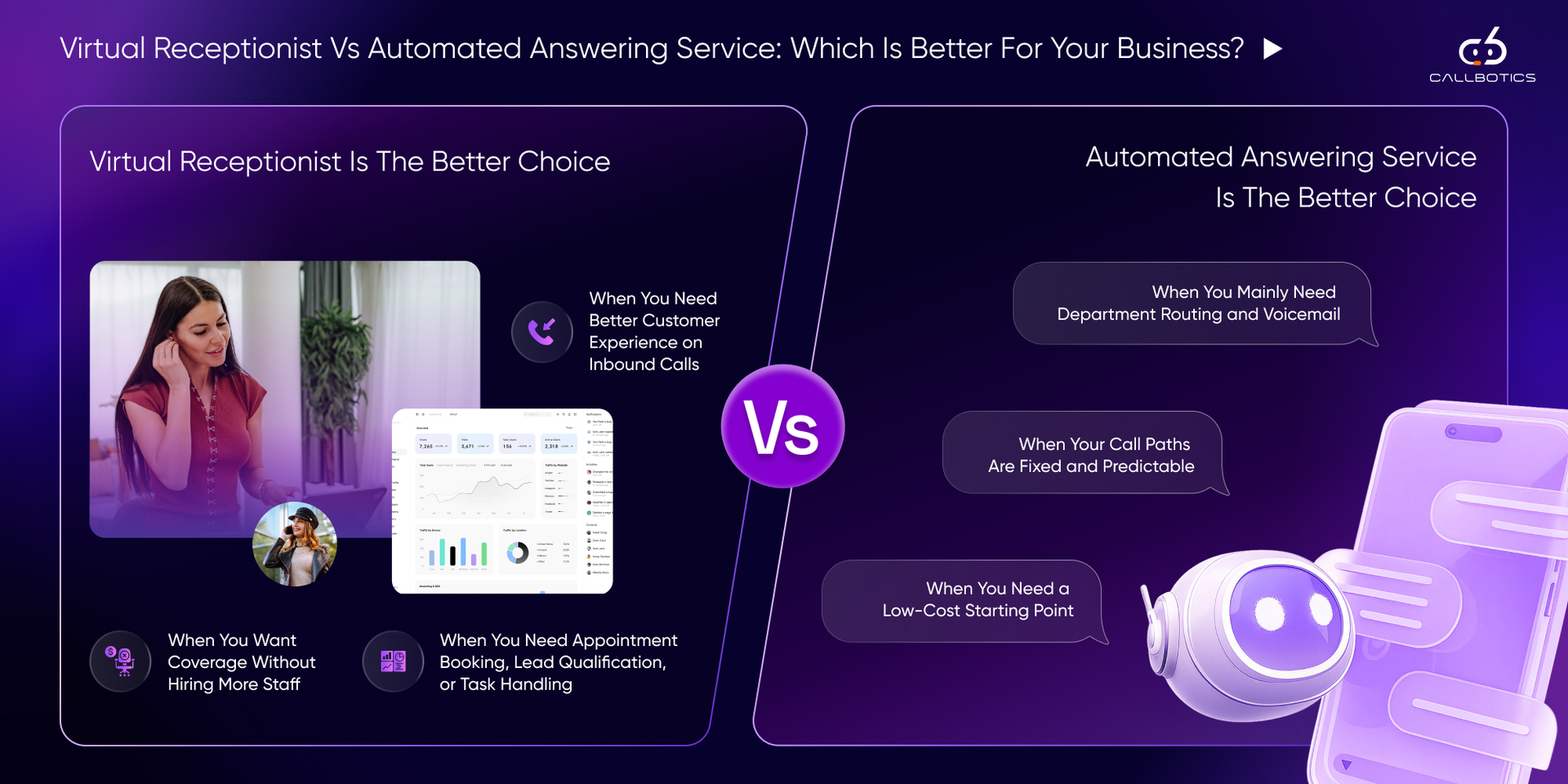
Virtual receptionists work best when inbound calls require conversation, context gathering, or task completion rather than simple routing.
Businesses that depend on phone interactions for customer service, appointment scheduling, or lead generation often need more than a menu system. In these situations, conversational call handling can improve both the caller experience and internal team efficiency.
Instead of navigating a menu tree, callers can explain their request naturally. The receptionist or AI-powered system interprets the request, gathers details, and determines the appropriate next step.
This approach works particularly well for organizations where calls frequently involve multiple steps, such as collecting customer information, confirming availability, or qualifying leads before routing them to the right team member.
Businesses that rely heavily on inbound calls for sales or customer relationships benefit significantly from conversational call handling.
When callers reach a menu-based system, they must translate their request into predefined options. If the menu does not match their situation, they may select the wrong option or abandon the call entirely.
Virtual receptionists remove this friction by allowing callers to explain their needs naturally.
Instead of navigating multiple prompts, a caller might simply say:
“I’m calling about scheduling a consultation.”
The receptionist can immediately gather the necessary information and route the caller appropriately. This type of interaction feels more natural and reduces the frustration that often comes with long menu trees.
Over time, conversational call handling can help businesses improve customer satisfaction, reduce abandoned calls, and create a more professional first impression.
Many industries require more than simple call routing.
In these cases, calls often involve gathering information, verifying details, or completing tasks before transferring the caller to the appropriate team.
Examples include:
A virtual receptionist can ask follow-up questions, collect important details, and capture context before the call reaches a specialist.
For example, a legal firm might receive calls from potential clients seeking representation. Instead of routing every call directly to an attorney, the receptionist can gather basic case details, confirm contact information, and determine urgency before transferring the call.
This not only improves efficiency for internal teams but also ensures that callers feel heard and supported during the initial interaction.
Small and growing teams often struggle to answer every inbound call during busy periods.
Missed calls can translate into missed revenue opportunities, especially for businesses that depend on phone inquiries for new leads or customer service.
Virtual receptionist services help solve this challenge by extending coverage without requiring additional in-house staff.
Calls can be answered even when internal teams are unavailable, such as during evenings, weekends, or peak workload periods.
Some organizations now use AI-powered receptionist systems to provide consistent call handling around the clock. These systems can greet callers, gather information, and escalate complex requests to human agents when necessary.
This allows businesses to maintain responsiveness while keeping staffing costs manageable.
Some companies extend coverage by using after-hours support with AI voice agents to ensure calls are answered outside regular business hours.
Automated answering services are often the right choice when calls follow predictable paths and require minimal conversation.
These systems are designed to route callers efficiently using predefined menu options. For organizations that receive a high volume of routine inquiries, menu-based routing can be a practical and cost-effective solution.
Instead of requiring a receptionist to answer each call, the system automatically directs callers to the appropriate department or information source.
If most callers simply need to reach a specific department, automated answering systems can handle this efficiently.
Common use cases include:
In these environments, callers typically know the department they need to reach. A simple menu system allows them to select the appropriate option quickly.
Automated answering services can also capture voicemail messages when staff are unavailable, ensuring that inquiries are not completely missed.
Businesses with highly standardized workflows often benefit from automated answering systems.
For example, a telecommunications provider might receive large volumes of calls related to account status, billing inquiries, or service outages.
In these cases, a structured menu system might guide callers through options such as:
Because these call paths remain consistent, automation works well and reduces the need for human involvement.
This approach can also improve operational efficiency by ensuring callers are routed to the correct team without requiring manual intervention.
Automated answering systems are often less expensive to implement than full receptionist services.
Because the system relies on prerecorded prompts and structured routing logic, it does not require conversational handling or human staffing.
For organizations with limited budgets or relatively simple call requirements, this makes automated answering a practical starting point.
As call volume grows or customer needs evolve, many businesses eventually upgrade to more advanced solutions that support conversational interactions or task completion during calls.
Cost differences between a virtual receptionist and an automated answering service depend largely on the type of interaction provided.
At a high level, automated answering services focus on routing calls, while virtual receptionist solutions handle conversations and tasks. The added capabilities typically introduce additional operational costs.
Understanding these pricing structures helps businesses evaluate the long-term value of each option.
Costs for automated answering services are typically tied to telephony infrastructure and system features rather than human labor.
Common pricing components include:
Because the system operates automatically, ongoing costs tend to remain relatively predictable.
Organizations that receive large volumes of routine calls often find this pricing model attractive because it scales efficiently without requiring additional staff.
Virtual receptionist services typically involve conversational interactions, which can increase operational costs.
Pricing models vary depending on whether the service is human-based, AI-powered, or hybrid.
Common pricing structures include:
AI-powered receptionist solutions can reduce labor costs while still maintaining conversational interactions with callers.
This allows businesses to handle more calls without hiring additional support staff.
Regardless of the solution chosen, businesses should evaluate potential hidden costs before committing to a platform.
These may include:
Understanding these factors helps organizations estimate the true long-term cost of their call-handling infrastructure.
Choosing between a virtual receptionist and an automated answering service ultimately depends on how callers interact with your business.
Instead of comparing features alone, organizations should evaluate the types of calls they receive and the outcomes they want to achieve.
A structured decision framework can help clarify which approach aligns best with operational goals.
The first step is analyzing why customers call your business.
Review call logs, support tickets, or CRM data to identify the most common reasons for inbound calls.
For many organizations, a small number of call types account for the majority of inbound volume.
Examples might include:
Understanding these call intents makes it easier to determine whether routing automation or conversational handling will deliver the most value.
One of the most important decision points is whether your call system needs to route calls or resolve them.
Routing-focused systems move callers to the appropriate department as quickly as possible. This works well when a human agent still needs to complete the task.
Resolution-focused systems attempt to handle the caller’s request during the interaction itself.
For example:
Routing approachCaller navigates a menu and is transferred to a support agent.
Resolution approachThe system gathers details, answers questions, or completes actions before escalation.
Businesses seeking to reduce call transfers or agent workload often prioritize resolution-oriented solutions.
Businesses that want to reduce transfers often focus on improving first-call resolution with AI voice agents instead of relying only on call routing.
Many organizations now combine both automated answering systems and conversational receptionist solutions.
In a hybrid model:
This approach allows businesses to scale efficiently while maintaining a high-quality caller experience.
See how businesses combine automation and conversational AI with CallBotics voice agents designed for modern contact center workflows.
Many businesses start with automated answering systems because they are simple to deploy. These systems route calls, play announcements, and collect voicemail messages when teams are unavailable.
However, routing alone rarely solves the caller’s problem.
When callers reach a menu system, they often still need to wait for an available agent to complete their request. This means the underlying workload for support or sales teams does not actually decrease. Calls are simply redirected.
Modern businesses increasingly need systems that can understand requests, collect context, and complete actions during the call.
CallBotics helps organizations move beyond basic automated answering by providing AI voice agents designed to function like a modern virtual receptionist. Instead of relying on menu navigation, these agents engage callers in natural conversations to understand intent and determine the best next step.
This allows businesses to shift from simple call routing toward call resolution and workflow automation.
CallBotics voice agents can:
Because the system gathers information before escalation, human agents spend less time asking basic questions and more time solving the actual problem.
This improves both operational efficiency and the caller experience.
For example, instead of navigating multiple menu options, a caller can simply say:
“I want to reschedule my appointment.”
The AI agent can confirm the caller’s identity, check availability in the scheduling system, and offer new time slots immediately. If the request requires human assistance, the system transfers the call along with a summary of the conversation so the caller does not need to repeat information.
This approach helps businesses reduce unnecessary transfers while improving first-call resolution.
Another advantage is operational visibility. Because conversations are captured and analyzed, teams gain access to detailed insights such as:
These insights help organizations improve call workflows and identify opportunities for further automation.
Understanding the difference between a virtual receptionist and an automated answering service helps businesses choose the right approach for their call-handling needs.
Automated answering services work well when calls follow predictable routing paths. Virtual receptionist setups are better suited for conversations, information capture, and task completion.
As contact center technology evolves, many organizations are combining automation with conversational AI to achieve both efficiency and improved caller experiences.
Choosing the right option ultimately depends on call complexity, customer expectations, and operational goals.

See how enterprises automate calls, reduce handle time, and improve CX with CallBotics.
CallBotics is an enterprise-ready conversational AI platform, built on 18+ years of contact center leadership experience and designed to deliver structured resolution, stronger customer experience, and measurable performance.