Real phone calls are messy, which is exactly why AI voice agent interruption handling matters in real contact center environments. People interrupt mid-sentence, talk over each other, change direction halfway through a conversation, or call from noisy places like cars, offices, or busy streets. Conversations are rarely clean or linear, and when a voice system cannot keep up with that reality, misunderstandings happen, responses feel off, and the customer experience starts to break down.
This matters more than ever because customer expectations are extremely sensitive to how interactions feel. Research shows that more than half of consumers will switch to a competitor after just one bad experience, which means even small breakdowns in a conversation can have a direct impact on retention and revenue.
This guide explains how AI voice agents handle interruptions, overlapping speech, and background noise, and what teams can do to make conversations feel smooth, responsive, and natural instead of rigid or frustrating.
Interruption handling is the ability of a voice AI system to deal with real conversation behavior without sounding confused, delayed, or robotic. In simple terms, it means the AI can tell when a caller starts speaking, stop at the right moment, listen to the new input, and continue the conversation without losing track of what was happening.
This matters because callers do not wait for perfect turn-taking. They often jump in with a correction, answer before the AI finishes, ask a new question midway, or respond while the system is still speaking. If the voice agent cannot handle it smoothly, the call quickly becomes awkward.
Good interruption handling usually comes down to three things:
For example, if the AI says, “Can I help you with your billing question today?” and the caller jumps in with, “No, I need to update my address,” the system should pause, recognize the new intent, and proceed from there. It should not finish its old script, ignore the interruption, or make the caller repeat themselves.
In practice, strong interruption handling helps calls feel more natural because the conversation can adjust in real time. It reduces friction, avoids people talking over each other for too long, and helps the voice agent stay aligned with what the caller is actually trying to do.
Interruptions and background noise are difficult for voice AI because real calls do not happen in perfect conditions. Callers speak casually, pause at odd moments, cut themselves off, correct what they just said, or talk from places with poor audio quality. That creates a very different environment from a clean demo or a scripted test.
This is also why “just use a better model” is not enough. A strong model helps, but voice performance also depends on timing, audio quality, turn-taking, speech detection, network stability, and how well the system handles incomplete or changing input. If those layers are weak, even a good model can sound confused or slow on live calls.
One of the biggest problems is that callers do not always sound clear. There may be background traffic, people talking nearby, poor phone microphones, muffled audio, or unstable mobile networks. Even when the caller knows exactly what they want, the audio reaching the system may be broken, distorted, or incomplete.
Accents and speaking styles add another layer of difficulty. People speak at different speeds, stress different words, and pronounce names, numbers, and addresses differently. If the system cannot handle that variation well, it may hear the wrong words, miss key details, or respond in a way that does not match what the caller actually said.
Overlapping speech happens when both sides talk at the same time. This can happen when the caller interrupts, when the AI responds too quickly, or when there is a slight delay on the line. In these moments, parts of the sentence can get lost, and the system may only catch half of what was said.
Cross-talk makes the conversation feel messy very quickly. The caller may stop, repeat themselves, or become unsure whether the system is listening. If the voice agent does not know when to pause, when to hand the turn back, or how to recover after both sides speak at once, the call starts to feel unnatural and frustrating.
Callers often do not give a clean, final answer in one go. They may start with one detail, stop, correct themselves, and then add something new. For example, someone might say, “I need help with my bill... actually, no, it is about my payment method.” That is normal human behavior, but it is hard for voice systems that expect neat, complete input.
This creates problems when the AI locks onto the first part too early or fails to notice the correction. Instead of following the updated meaning, it may continue down the wrong path. Good voice AI needs to handle partial answers carefully so it can keep up with the caller without forcing them to repeat everything.
Explore how CallBotics supports smoother AI voice calls with faster recovery, clearer handoffs, and built-in call quality insight.Modern voice AI does not handle interruptions by guessing. It uses a set of timing and listening controls that help it decide when to speak, when to stop, and when to listen. The goal is simple: make the call feel natural, even when the caller interrupts, pauses, or changes direction.
Voice activity detection, or VAD, helps the system recognize when the caller has started speaking. This matters because the agent needs to notice speech quickly enough to stop talking or pause before the conversation turns into a cross-talk mess.
Barge-in allows the caller to interrupt the agent naturally, without waiting for the full scripted response to finish. This is important in live calls because people often answer early, correct the system, or ask a new question before the agent is done speaking.
End-of-turn detection helps the agent determine when the caller has finished speaking and is ready to respond. Without this, the system may reply too early, cut the caller off, or wait too long, creating awkward silence.
Even strong voice systems sometimes miss a word or two, especially on noisy calls. Short reprompts and confirmations help the agent recover without making the conversation feel heavy or repetitive.
Overlapping speech is what happens when the caller and the voice agent speak at the same time. In real calls, this happens all the time. A caller may interrupt to correct something, answer early, or ask a new question before the agent has finished speaking. If the system cannot recover well, the call starts to feel messy very quickly.
Good voice AI does not try to force perfect turn-taking. Instead, it is designed to pause, listen, recover what it missed, and continue without making the caller repeat the entire interaction. That is what makes the experience feel smooth instead of robotic.
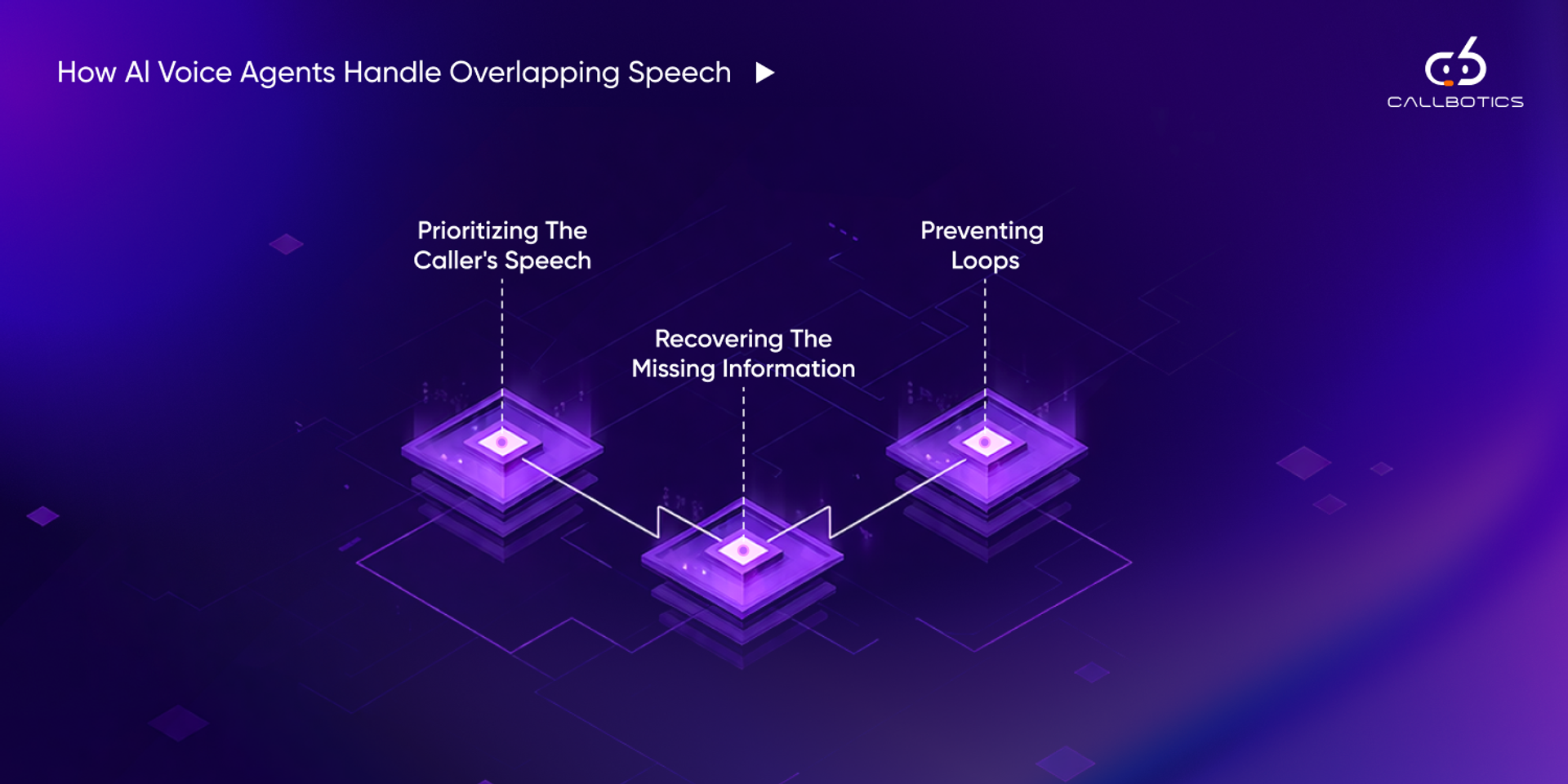
When both sides start talking at once, the caller’s voice should take priority. The agent should stop speaking as soon as it detects that the caller is trying to say something. This helps the conversation feel respectful and natural.
If the agent keeps talking over the caller, even for a few extra seconds, the experience becomes frustrating. The caller may stop, repeat themselves, or feel like the system is not really listening. Letting the caller finish is often the fastest way to get the conversation back on track.
When speech overlaps, part of the message may get lost. In those moments, the best response is not to restart the whole flow. The system should identify the missing piece and ask one short, clear follow-up to fill that gap.
For example, if the caller says part of their account detail while interrupting the agent, the next step should be something simple like, “I caught the first part. Can you repeat the last four digits?” That keeps the call moving and avoids making the caller go back to the beginning.
One common problem in overlapping speech is that the system repeats the same prompt even though the caller has already answered it. This usually happens when the agent catches only part of the response and fails to update the conversation state correctly.
Good voice AI avoids this by retaining whatever useful information it has received and only asking for what is still missing. That prevents the call from getting stuck in a loop where the caller keeps hearing the same question again and again, even after they have already responded.
Background noise is one of the most common reasons voice calls break down. Callers may be speaking from a car, a crowded office, a street, or a room with poor acoustics. In those moments, the system has to do more than just “listen.” It has to separate the caller’s speech from everything else and still keep the conversation moving clearly.
Before the system can understand what the caller said, it first needs to improve the audio quality. Noise suppression and audio cleanup help reduce unwanted sounds, making the caller’s voice easier to detect and process.
Phone calls do not sound like studio recordings. The audio is narrower, less clean, and often compressed by mobile networks or telephony systems. That is why voice AI needs speech recognition that is tuned for real phone conversations, not ideal audio conditions.
Sometimes the audio is simply too unclear to trust. In those cases, the best systems do not keep guessing. They simplify the conversation, confirm the critical details, or move the caller to a human when needed.
Strong interruption handling usually comes from conversation design, not just speech technology. If the flow is too long, too complex, or too rigid, even a capable voice agent will struggle on a messy live call.
The goal is to make the interaction easier to follow in real time. That means keeping questions clear, reducing the chances of people talking over each other, and giving the system simple ways to recover when audio quality drops or a caller cuts in.
Long prompts increase the chance that callers will interrupt before the agent finishes. Most people do not wait through a full scripted sentence if they already know what they want to say. They jump in, correct the agent, or answer early.
Short prompts make turn-taking easier. They give the caller less to process, reduce cross-talk, and lower the chance that important words get lost when both sides start speaking at once.
Multi-part questions create problems on noisy calls because the caller may only hear part of what was asked. If the agent asks for a name, date of birth, and claim number in one sentence, there is a higher chance that one piece gets missed or answered out of order.
One clear question at a time makes the call easier to follow. It also makes recovery easier, because if something is unclear, the agent only has to repeat or confirm one detail instead of restarting a longer request.
Names, dates, numbers, addresses, and account details are the parts most likely to break when audio quality is poor. Even a small error in one of these fields can send the conversation in the wrong direction.
That is why important details should be confirmed before the call moves forward. A quick check like “I heard April 14, is that right?” is much better than assuming the system heard everything correctly and creating a bigger problem later.
Not every missed word needs a full restart. When the system loses part of the answer, a short recovery prompt can keep the conversation moving without making the call feel stiff or repetitive.
The best recovery prompts are simple and specific. Instead of asking the full question again, the agent should focus only on the unclear part, such as “I didn’t catch the last four digits” or “Could you repeat the street name?” That feels more natural and saves time.
Some calls are too noisy, too unclear, or too sensitive to keep pushing through automation. In those cases, the best experience is often a quick transfer to a human instead of repeated retries that frustrate the caller.
That matters because customers still want a human option when automation starts to feel unreliable. In a 2026 SurveyMonkey study, 79% of Americans said they strongly prefer interacting with a human over an AI agent. When a call is already breaking down because of noise or repeated mishearings, a fast human handoff protects the experience instead of dragging the caller through more friction.
Learn how CallBotics improves real-world voice automation with smarter interruption handling and cleaner fallback paths.If interruption handling is weak, you will usually see the impact in call behavior before anyone reports it directly. Callers hang up early, repeat themselves more often, get routed to the wrong flow, or end up transferring out of calls that should have been handled cleanly.
That is why teams should track a small set of practical metrics tied to call quality and flow control. These KPIs help you see whether interruptions, overlapping speech, and poor audio are quietly hurting resolution, speed, and customer experience.
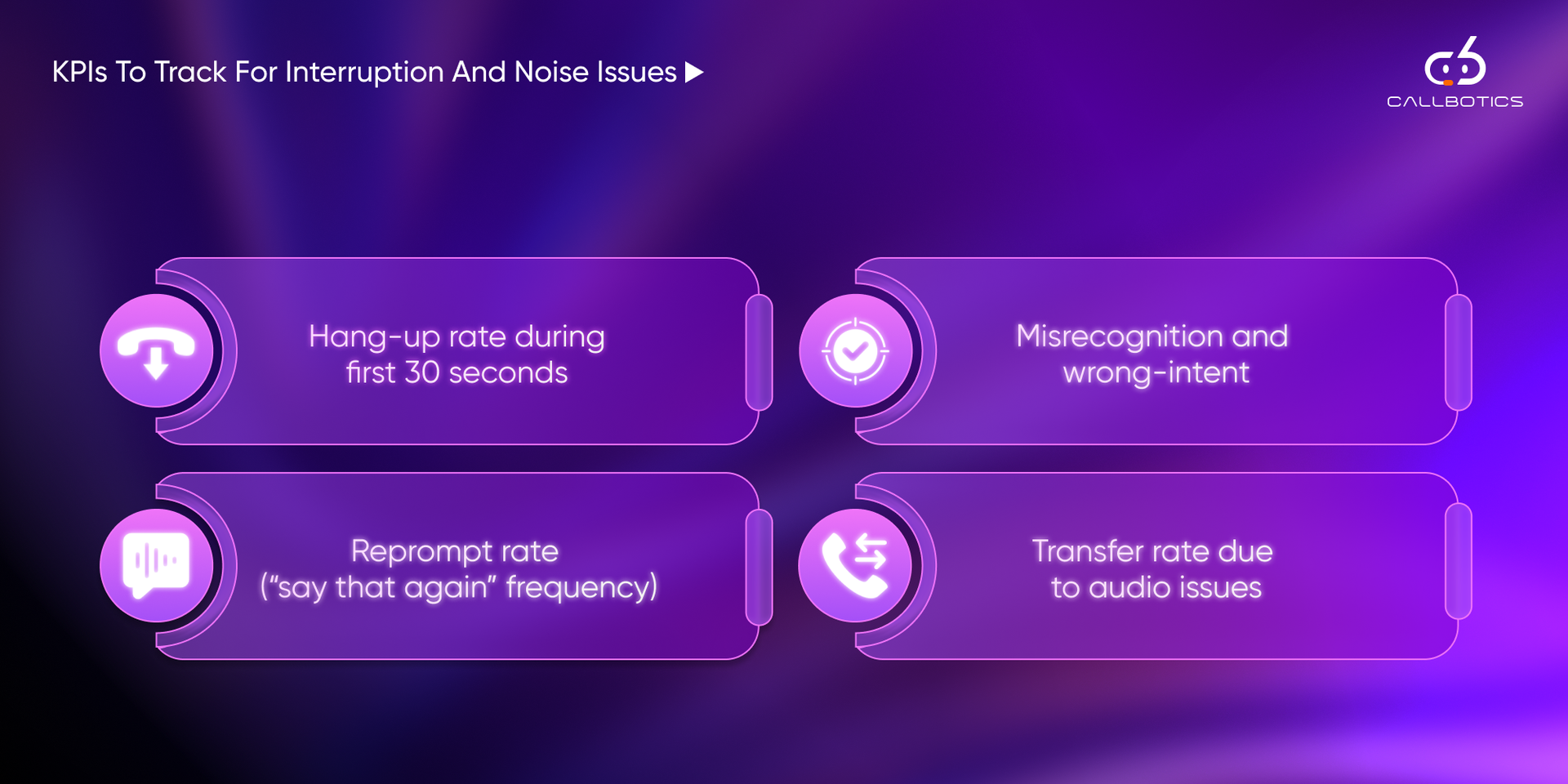
Early hang-ups are often one of the clearest signs that something is going wrong at the start of the call. If the agent responds too slowly, talks too long before getting to the point, or handles turn-taking poorly, callers may disconnect before the interaction really begins.
The reprompt rate indicates how often the agent has to ask the caller to repeat themselves. A small amount is normal, but if it happens too often, the call starts to feel slow, frustrating, and unnatural.
This metric shows how often the agent misunderstands what the caller said or chooses the wrong next step. That can happen when audio is unclear, speech overlaps, or the caller changes direction mid-sentence, and the system does not keep up.
A transfer is not always a failure. Sometimes it is the right decision, especially when the audio is too poor to continue confidently. The key is to separate healthy transfers from unnecessary ones caused by weak interruption handling or poor recovery design.
Improving call quality in real-world conditions usually comes down to handling a few common problems well. Callers interrupt the agent, speak over the agent, call from noisy locations, or give incomplete answers the first time. They want the conversation to keep moving without awkward pauses, repeated questions, or responses that miss the point.
That is where CallBotics fits in. Built on 18+ years of contact center leadership experience, CallBotics is designed for real service environments where calls are rarely clean or predictable. In practice, it helps teams manage interruptions more smoothly, confirm important details when audio is unclear, recover without restarting the whole flow, and use built-in analytics to spot where noise or cross-talk is hurting performance.
With CallBotics, teams can improve call quality in noisy, real-world calls by:
Interruption handling is not just one feature you turn on. It is a combination of fast turn-taking, short and clear prompts, the ability to pause at the right time, and simple recovery when something is missed. When these pieces work together, the conversation feels natural, even when the caller interrupts, speaks over the agent, or calls from a noisy environment.
The goal is to keep the call moving without making the caller repeat themselves or feel stuck. That means handling overlaps cleanly, confirming important details when needed, and knowing when to escalate to a human instead of forcing the interaction forward. When done right, interruption handling helps voice AI stay clear, responsive, and reliable in real-world conditions, not just in ideal scenarios.

Anindita Majumder is a content and copywriter with about four years of experience across content writing, copywriting, and journalism. Her work has involved building and shaping content for global brands in B2B SaaS tech, healthcare, travel tech, edtech, and more. Her love for reading often spills into the way she ideates. Outside of work, she is a vocalist, which keeps her creativity flowing.
See how enterprises automate calls, reduce handle time, and improve CX with CallBotics.
CallBotics is an enterprise-ready conversational AI platform, built on 18+ years of contact center leadership experience and designed to deliver structured resolution, stronger customer experience, and measurable performance.