Utility companies deal with some of the most unpredictable customer service demand in any industry. On a normal day, customers call about bill explanations, payment support, meter readings, service changes, account updates, move-in and move-out requests, and appointment windows. During outages, storms, billing cycles, or service disruptions, that demand can rise quickly because customers want one thing immediately: a clear update on what is happening and what they should do next.
This pressure is especially important in 2026 because outage communication has become a bigger customer experience issue. J.D. Power reported that 55% of utility customers nationwide experienced a power outage in 2025, increasing the pressure on utilities to communicate clearly before, during, and after restoration. For contact centers, that means the challenge is not just more calls. There are more customers calling at the same time, often with urgent questions, limited patience, and a need for accurate information.
AI voice agents help utility companies manage this demand without forcing every customer into a long queue. They can answer supported bill inquiries, provide outage updates, confirm service request status, guide payment-related questions, collect required details, and escalate complex cases with context. The real value is not replacing human agents. It is giving customers faster answers for high-volume interactions while keeping human teams available for emergencies, vulnerable-customer needs, and cases that require judgment.
Utility customer support is difficult because demand is rarely steady. A normal day can involve billing questions, payment support, service changes, meter issues, and appointment requests. But during outages, storms, service interruptions, or billing cycles, call volume can rise quickly. Customers are often stressed, agents need accurate information, and every delay can create repeat calls, complaints, or unnecessary escalations. Support teams also have to balance speed with accuracy because a wrong update can create more confusion than no update at all.
Outages create immediate pressure because many customers call at the same time for the same reason. They want to know what happened, whether the issue has been reported, when service will return, and whether there is anything they need to do. Traditional contact centers often struggle because staffing levels are planned for normal demand, not sudden disruption. A short service interruption can still overwhelm support if thousands of customers try to reach the utility at once.
Utility interactions are often urgent because they affect daily life. A customer without power, gas, water, broadband, or another essential service does not want a generic response. They want a clear update, a realistic next step, and confidence that the issue is being handled. Customer trust depends on whether the provider communicates clearly while the issue is still active, not only after it is resolved.
Many utility calls are predictable, but they still take up agent time. Customers often ask about bill amounts, due dates, payment options, meter readings, service transfers, new connections, disconnections, and appointment windows. These interactions may be simple, but at scale, they create a heavy workload. When simple requests are handled manually every time, agents have less time for vulnerable customers, dispute cases, and complex service problems.
Utility support teams often need information from more than one system before they can answer a customer properly. Billing platforms, outage management systems, CRM records, meter data, field service tools, and payment systems may all hold part of the answer. When these systems are not connected, agents spend more time searching, verifying, and updating information. This makes utility support harder than simple call answering because the right response often depends on live operational data.
AI voice agents help utility companies handle high-volume customer calls without making every customer wait for a live agent. They can answer common questions, collect required details, check information from connected systems, and guide customers through supported service steps. For utility teams, the value is practical: faster responses for customers, less avoidable workload for agents, and more consistent handling across billing, outage, and service-related interactions.
An AI voice agent can greet the customer, understand the reason for the call, verify basic account details, and provide the next best response based on approved utility workflows. For example, it can share an outage update, explain a bill, confirm a payment status, log a service request, or route a complex issue to the right team with context. This helps the contact center manage routine demand while keeping human agents available for cases that need judgment, empathy, or manual review.
See how CallBotics helps utility teams manage outage calls, bill inquiries, and service requests with AI voice agents.AI voice agents are most useful in utility support when the request is high-volume, time-sensitive, and follows a clear service path. Many customer calls are not complex at the start. They become complex when customers wait too long, repeat information, or get transferred without context. Clear automation works best when the utility has approved workflows, reliable data access, and escalation rules already defined.
For utilities, the strongest use cases are the ones that reduce avoidable queues while keeping the customer informed. AI voice agents can help with billing, outage updates, service requests, appointment scheduling, and proactive communication, while human agents stay focused on exceptions, complaints, vulnerable customer needs, and cases that require manual review. This makes the contact center easier to manage during both normal demand and sudden service events.
Billing calls are one of the most common reasons customers contact utility providers. Customers may want to understand a higher-than-usual bill, confirm a due date, check whether a payment was received, request payment guidance, or ask about available billing options. These calls need careful handling because billing confusion can quickly turn into frustration or repeat contact.
AI voice agents can guide these calls using approved billing workflows and connected account data where integration is available. They can answer supported questions, explain next steps clearly, and route disputes or sensitive payment issues to the right team with the customer’s context already captured. This helps customers get faster answers while keeping complex billing cases with the right human team.
Outages create pressure because customers often call at the same time with the same urgent question: “When will service be restored?” Without automation, live agents can get overwhelmed by status-check calls that may not require manual handling. Customers also expect the information to be current, clear, and specific to their area where possible.
AI voice agents can let customers report an outage, check whether an outage is already known, share available restoration updates, and confirm the customer’s location or account details. When the issue is complex, unsafe, or not covered by the available update, the call can be escalated with the right context. This keeps customers informed while helping live teams focus on safety issues, exceptions, and field coordination.
Utility customers often call to report service problems such as low water pressure, meter concerns, damaged equipment, broadband issues, or account-related service faults. These calls need clear intake because missing details can delay resolution. Accurate information at the first point of contact helps support teams route the request correctly.
AI voice agents can collect the required information step by step, confirm the issue type, capture location details, and create or prepare a service request in the connected system. They help standardize intake so field teams and support teams receive cleaner information from the start. This reduces back-and-forth and gives customers more confidence that their issue has been recorded properly.
Service visits can create a lot of back-and-forth for customers and agents. Customers may need to book a technician visit, reschedule an appointment, confirm arrival windows, or understand what they need to prepare before the visit. Missed appointments or unclear instructions can increase call volume and delay service completion.
AI voice agents can support appointment scheduling by checking available slots where system access is available, confirming customer preferences, sending confirmation details, and handling simple rescheduling requests. This reduces manual coordination and helps customers get a clear next step without waiting in a queue. It also helps support teams keep appointment-related communication consistent across customers.
Utility support should not only respond after customers call. During outages, planned maintenance, billing cycles, payment deadlines, or service appointments, proactive communication can reduce inbound pressure and improve customer trust. Customers are less likely to call repeatedly when they receive timely updates through the right channel.
AI voice agents can place outbound calls or notifications to share outage updates, planned maintenance reminders, payment reminders, appointment confirmations, and follow-up instructions. This helps customers stay informed before they need to contact the utility, while support teams reduce avoidable repeat calls. Proactive communication also gives utilities a practical way to manage expectations during high-demand periods.
AI voice agents improve utility customer experience by reducing the delays and confusion that often happen during high-demand periods. Customers usually do not want a long explanation. They want their call answered, their issue understood, and the next step explained clearly. Utility teams also need a way to keep service quality stable when call volume changes suddenly. For utility companies, this can improve wait times, response speed, support availability, and message consistency across common customer interactions.
The impact is strongest when AI voice agents are connected to approved workflows and reliable customer or service data. This keeps automation useful without making customers feel like they are being pushed through a generic phone menu.
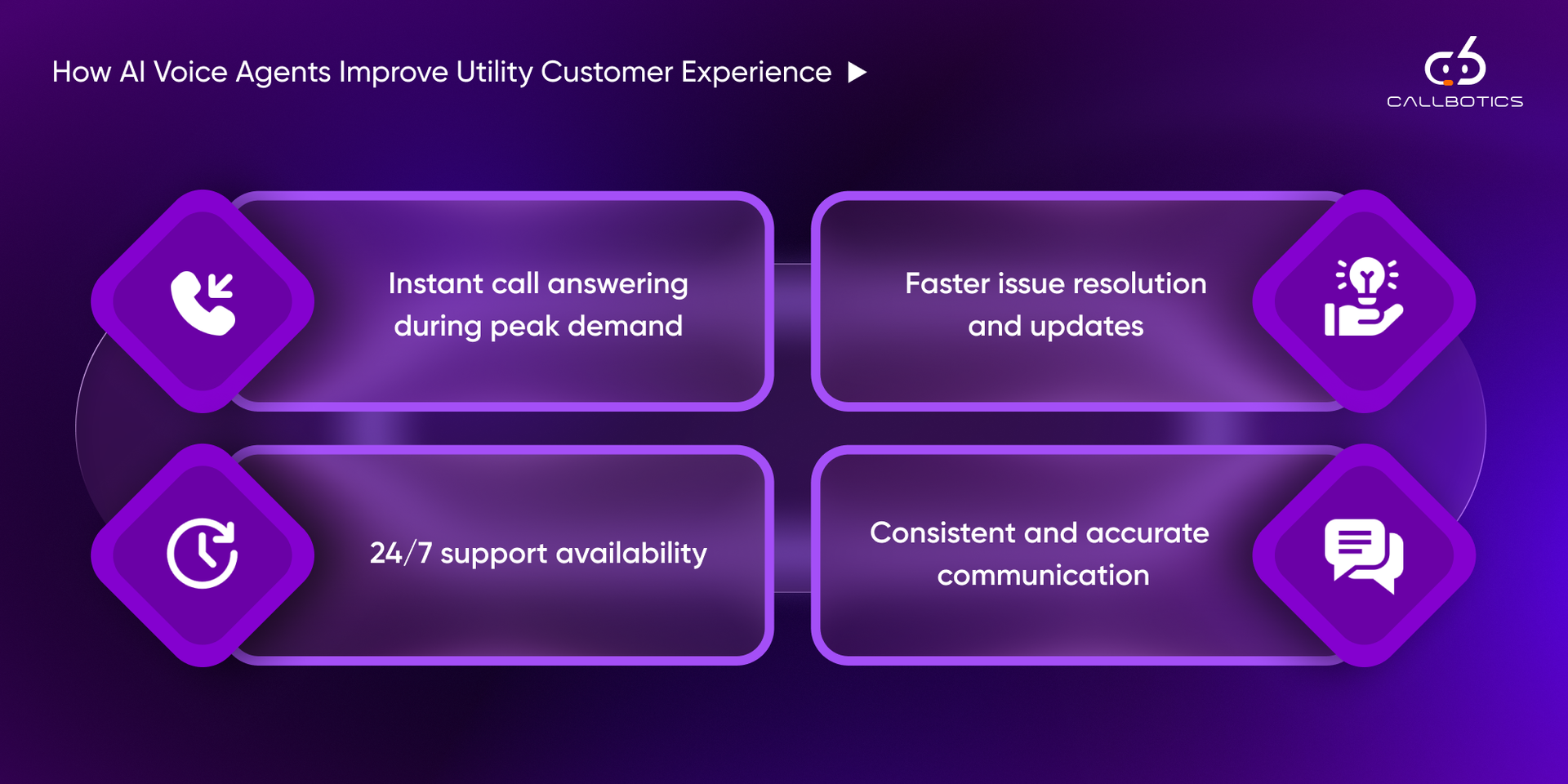
Peak demand is one of the biggest customer experience challenges for utility providers. During outages, storms, billing cycles, or planned maintenance, call queues can build quickly and customers may call again if they cannot get an answer. Long hold times make customers feel ignored, even when the utility is actively working on the issue. Faster call answering helps reduce pressure on both customers and live support teams. AI voice agents can absorb a large share of supported, high-volume calls before they become queue pressure. This helps the contact center stay responsive when live agent capacity is limited.
Customers contact utility providers because they need a clear answer or action. When updates are slow or unclear, customers may call repeatedly, escalate the issue, or lose confidence in the provider. Speed matters most when the customer is dealing with an outage, billing concern, missed appointment, or service interruption. A clear update can reduce repeat calls even when the issue itself is still being resolved. AI voice agents can help by giving customers the latest approved information available through connected systems or configured workflows. They also make it easier to capture the reason for the call before a human agent needs to step in.
Utility issues do not always happen during business hours. Customers may need help late at night, early in the morning, on weekends, or during major service disruptions when agent capacity is limited. After-hours demand is difficult to staff because volume can be unpredictable. Always-available support helps customers get basic answers without waiting for the contact center to reopen. AI voice agents can handle supported interactions around the clock, as long as the right workflows and escalation rules are configured. This gives customers a practical support path while protecting live teams from preventable backlog the next day.
Utility customers need reliable information, especially when the issue affects their home, business, or daily routine. Mixed messages from different agents or channels can create confusion and increase repeat contact. Consistency is also important during outages or planned work because customers often compare updates across phone, SMS, email, website, and app channels. Clear, standardized communication helps reduce uncertainty and keeps customers aligned with the latest approved guidance. AI voice agents can follow the same approved language and decision paths for every supported interaction. This reduces variation in how common questions are answered across teams, shifts, and locations.
AI voice agents create business impact by helping utility providers manage high-volume customer interactions with more control. The biggest value comes from handling supported requests consistently, reducing avoidable live-agent workload, and keeping service communication responsive during demand spikes. Utility providers also gain a more reliable way to manage demand without depending only on overtime, overflow teams, or temporary staffing. This becomes especially important when service events create pressure across customers, agents, supervisors, and field teams at the same time.
For utility leaders, this is not only a customer experience improvement. It also affects staffing pressure, cost per interaction, agent productivity, escalation quality, and the contact center’s ability to stay stable during outages, billing cycles, and service disruptions. AI voice agents are most effective when they support clearly defined workflows and pass complex cases to human teams with useful context. That balance helps providers improve efficiency without weakening service quality.
Utility contact centers spend a large amount of time on questions that follow a predictable path. Customers call to check bills, confirm due dates, report outages, ask for service status, reschedule appointments, or request basic account updates. These interactions are important, but many do not require a live agent from the beginning. When every simple request enters the same queue, agents lose time that could be used for higher-risk or more complex cases.
AI voice agents can handle many of these supported interactions without sending every call to a live agent. This reduces avoidable workload and gives human teams more time for disputes, vulnerable customers, safety concerns, complaints, and cases that need judgment. It also helps supervisors manage queues with more confidence because simple requests are not competing with urgent issues for the same agent capacity. Cleaner call routing can reduce unnecessary transfers and make the overall support operation easier to control.
Outages can create sudden call surges that are difficult to manage with fixed staffing levels. Even a well-run contact center can struggle when thousands of customers call at the same time for outage status, estimated restoration, or reporting confirmation. Customers may call repeatedly if they cannot get through or if the update is unclear. This creates extra pressure on support teams while field operations are already working through restoration priorities.
AI voice agents help utilities scale response capacity during these spikes by answering supported outage-related calls at the same time. They can provide approved updates, collect outage reports, confirm known issues, and escalate urgent or unsafe situations with context. This helps customers receive timely information without waiting for every call to reach a live agent. It also protects live teams from being overloaded by status-check calls that can be handled through approved outage workflows.
Utility contact centers are expensive to scale manually because peak demand does not always follow a predictable pattern. Hiring enough agents for every possible outage, billing surge, or seasonal spike can leave teams overstaffed during normal periods and still stretched during emergencies. Overtime and overflow support can help, but they often increase cost without fully solving queue pressure. Cost also rises when customers call repeatedly because the first interaction did not provide a clear answer or next step.
AI voice agents reduce cost by shifting supported, high-volume interactions away from manual handling where appropriate. This can lower cost per interaction, reduce overtime pressure, limit avoidable repeat calls, and help live agents spend more time on higher-value customer issues. The financial benefit is strongest when automation is tied to actual resolution, not just call deflection. Utility providers can also track which interactions are being resolved, escalated, or repeated, making cost control easier to measure over time.
Explore how CallBotics supports high-volume utility customer interactions with faster answers, cleaner escalation, and operational visibility.Utilities handle essential services, so AI voice agents need to be designed with security, accuracy, and reliability from the start. These systems may support billing questions, outage updates, service requests, payment guidance, and account-related interactions. That means they must protect customer data, use approved information, and remain dependable when demand is high. Utility customers may be under stress when they call, especially during outages or service disruptions. A secure and reliable AI voice agent helps reduce confusion while keeping sensitive information and service communication under control.
Utility support often involves personal, account, billing, service address, and payment-related information. AI voice agents need secure access controls, clear data-handling rules, and safe integration with customer systems so sensitive information is not exposed or misused. Data protection also depends on collecting only the information needed for the interaction. Customer trust can be damaged quickly if account details, payment information, or service addresses are handled carelessly.
Outage communication needs to be clear, current, and based on approved operational data. A wrong restoration update or unclear safety instruction can create confusion, increase repeat calls, and damage customer trust. AI voice agents should not guess when outage details are unavailable or still being confirmed. The safest experience is one that explains what is known, what is not yet confirmed, and what the customer should do next.
Utility customer support cannot depend on systems that fail during peak demand. During outages, storms, billing cycles, or emergency events, AI voice agents need to remain available, responsive, and connected to the right systems where possible. Reliability matters because customers often contact utilities when the service situation is already urgent or uncertain. If automation fails at the same time as service demand rises, the contact center can face even more pressure.
AI voice agents work best when they are introduced with clear priorities, reliable data access, and practical escalation rules. Utility providers should not try to automate every customer interaction at once. The better approach is to start with use cases that are common, structured, measurable, and safe to support through approved workflows. This helps teams prove value quickly without putting high-risk or unclear interactions into automation too early.
A strong implementation also needs planning for real utility conditions. Outages, billing spikes, service disruptions, vulnerable customers, and emergency situations all require careful design. AI voice agents should make customer support faster and more consistent, while keeping human teams available when the interaction needs judgment, empathy, or urgent review. Clear boundaries help the system support customers safely without overstepping what automation should handle.
The best starting point is usually the work that creates the most avoidable pressure on the contact center. Billing questions, payment status, outage updates, appointment confirmations, and service request status are often strong candidates because they follow clear steps and happen frequently. These workflows also give operations leaders a practical way to measure whether AI voice agents are reducing queue pressure and improving response speed.
Starting with high-volume workflows also makes performance easier to measure. Utility leaders can track call containment, resolution rate, wait time reduction, escalation quality, repeat contact, and cost per interaction before expanding AI voice agents into more complex use cases. This creates a safer rollout path because teams can refine workflows before moving into higher-risk interactions.
AI voice agents need access to the right information to give useful answers. Utility customers often ask questions that depend on billing records, payment status, outage systems, service addresses, appointment schedules, meter data, or field service updates. Accurate data access is what allows the AI voice agent to move beyond generic responses and provide customer-specific support.
Without integration, AI voice agents can only provide general information, which limits their value. With secure access to approved systems, they can verify details, retrieve relevant updates, complete supported steps, and escalate cases with cleaner context for human agents. Strong integration also reduces the chance of customers receiving incomplete answers or being asked to repeat information after escalation.
Utility support must be designed for situations where the customer’s issue may be urgent or safety-related. Calls involving gas smell, downed wires, flooding, electrical hazards, medical dependency, or loss of critical service should never be treated like standard support requests. These scenarios need approved language, fast routing, and clear rules for when automation should stop and human or emergency handling should begin.
AI voice agents should be configured to recognize emergency language, give approved safety instructions where appropriate, and route urgent cases immediately. This protects customers, reduces operational risk, and keeps automation aligned with the utility’s crisis-response procedures. Regular testing is important because emergency handling must work reliably during real service events, not only during setup.
Not every utility interaction should stay with an AI voice agent. Complex billing disputes, vulnerable customer situations, safety concerns, complaints, unclear outage cases, and policy exceptions may need a trained human agent. A good implementation defines these escalation points before the AI voice agent goes live.
The escalation experience should feel smooth for the customer. AI voice agents should pass the call reason, customer details, collected information, interaction summary, and next recommended step to the human team so the customer does not have to start over. This reduces customer frustration and helps live agents resolve the case faster with better context.
Utility voice AI should be measured by how well it improves real customer service performance, not by how many calls it answers alone. The right KPIs show whether AI voice agents are reducing queue pressure, resolving supported interactions, improving customer experience, and helping human teams focus on more complex work. Utility leaders also need to separate simple call handling from true customer outcomes. A strong measurement plan helps teams see where AI is working, where customers still need human support, and where workflows need improvement.
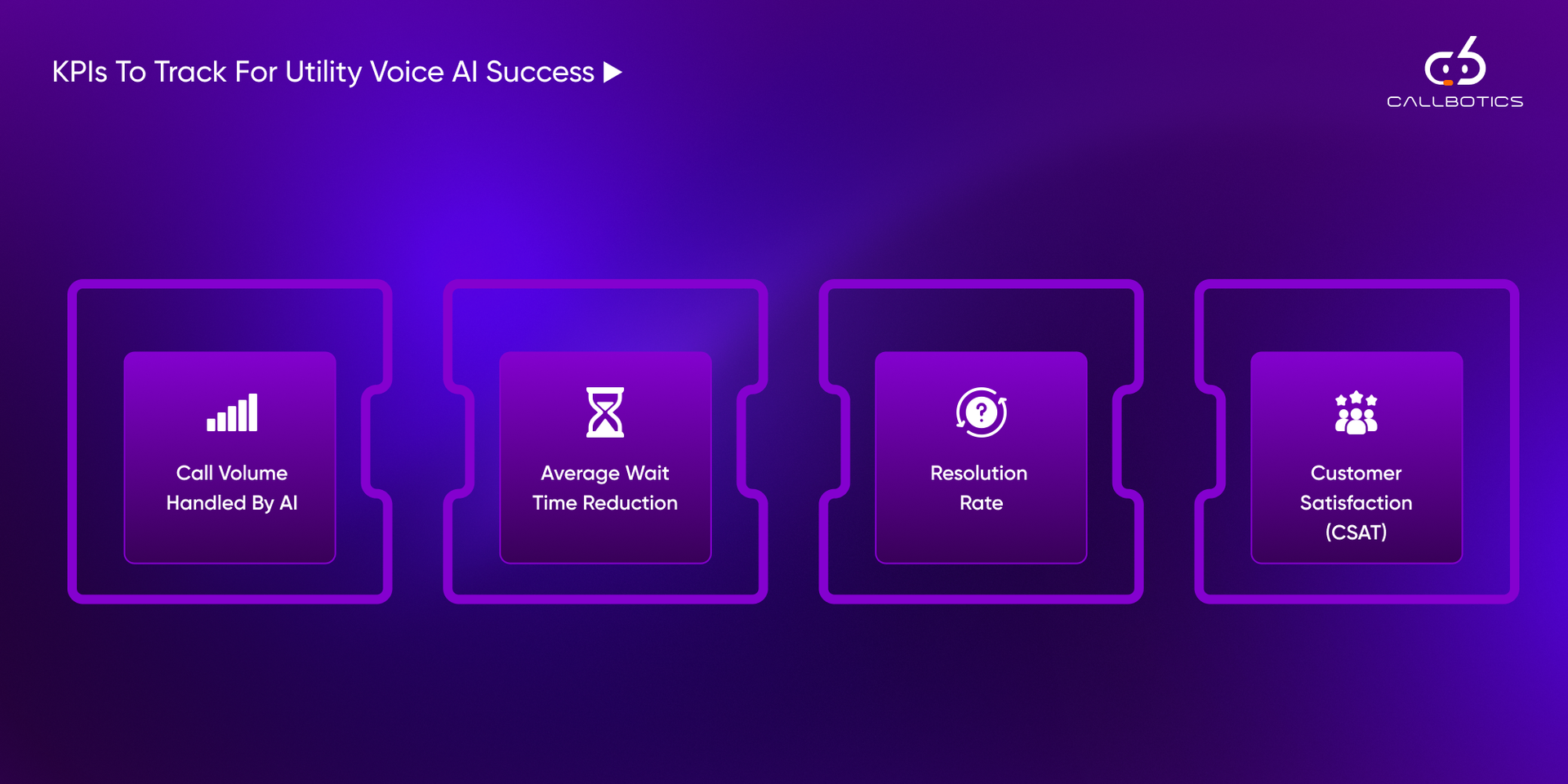
Call volume handled by AI shows how many customer interactions are being managed by AI voice agents instead of going directly to live agents. This metric helps utility leaders understand whether automation is reducing avoidable workload across billing, outage updates, service request status, appointment confirmations, and other supported use cases. The number should be reviewed by interaction type because some utility requests are easier to automate than others. High AI-handled volume is useful only when customers are receiving accurate answers or being escalated properly.
Average wait time reduction shows whether AI voice agents are helping customers get faster access to support. This is especially important during outages, billing cycles, storms, planned maintenance, or other high-demand periods when queues can build quickly. Lower wait time can improve customer experience, but it should be measured alongside resolution and escalation quality. A customer who gets answered quickly still needs a useful next step.
Resolution rate shows whether AI voice agents are actually helping customers complete the reason for their call. A utility provider should not only measure whether the AI answered the call, but whether the customer received a clear update, completed a payment-related step, logged a service request, confirmed an appointment, or was escalated correctly. Resolution should be defined before launch so teams know what a successful outcome looks like for each use case. This keeps reporting grounded in customer outcomes instead of generic automation numbers.
CSAT shows whether customers feel the interaction was helpful, clear, and easy to complete. For utilities, this matters because customers often call during stressful moments, such as outages, billing concerns, missed appointments, or service disruptions. CSAT should be reviewed with the interaction context because a low score may reflect the service issue itself, not only the AI voice agent. Pairing CSAT with resolution, wait time, and repeat contact gives leaders a more accurate view of customer experience quality.
CallBotics helps utility providers automate high-volume customer interactions across billing, outage communication, and service workflows. Its AI voice agents can answer supported bill inquiries, provide approved outage updates, collect service issue details, and route complex cases to human teams with context. This helps utilities reduce avoidable queues while keeping customers informed during normal operations and peak demand. The goal is not to remove human support, but to make sure live agents are available for emergencies, vulnerable customers, disputes, and cases that need judgment.
AI voice agents give utility companies a practical way to manage high-demand customer service without relying only on live-agent capacity. They can support common interactions such as bill inquiries, outage updates, service requests, appointment confirmations, and proactive notifications. Complex or urgent cases can still move to human teams with context, which helps protect service quality when customers need extra care.
Customers get faster answers, shorter wait times, clearer updates, and support beyond normal business hours. Utility providers get less avoidable call volume, better scalability during outages, lower operational pressure, and more consistent communication across routine and peak-demand scenarios. The strongest results come when AI voice agents are connected to approved workflows, reliable systems, and clear escalation rules. Used this way, they help utility teams keep service responsive, accurate, and easier to manage when demand rises.

Urza Dey (She/They) is a content/copywriter who has been working in the industry for over 5 years now. They have strategized content for multiple brands in marketing, B2B SaaS, HealthTech, EdTech, and more. They like reading, metal music, watching horror films, and talking about magical occult practices.
See how enterprises automate calls, reduce handle time, and improve CX with CallBotics.
CallBotics is an enterprise-ready conversational AI platform, built on 18+ years of contact center leadership experience and designed to deliver structured resolution, stronger customer experience, and measurable performance.