Not all AI agents are built to execute real operational work.
As enterprises move beyond basic chat automation, the focus has shifted to systems that can interpret intent, coordinate multiple models, and complete structured actions across backend platforms. The difference between conversational AI and true workflow orchestration directly impacts reliability, governance, and production performance.
Sierra AI has positioned itself as a multi-agent orchestration platform designed for complex, action-driven enterprise environments. Rather than operating as a single conversational layer, it routes tasks across specialized agents and models to execute multi-step workflows.
This Sierra AI review examines how the platform works, its architecture and features, pricing structure, security posture, deployment realities, and how it compares with CallBotics for enterprise voice automation.

Source: Sierra AI Homepage
Sierra AI is a multi-agent orchestration platform designed for enterprises that need AI agents to execute complex, multi-step workflows across integrated systems. Rather than simple chat automation, it focuses on structured execution such as retrieving data, updating records, and completing transactions.
Founded by Bret Taylor and Clay Bavor, Sierra positions itself as an enterprise-grade AI execution layer built on a constellation-of-models approach, in which specialized agents collaborate to interpret intent, perform actions, and validate outcomes.
Sierra AI is commonly used for:
It is best suited for organizations with complex operational needs and internal engineering resources.
Sierra AI operates as a multi-agent orchestration platform rather than a single conversational bot. Instead of relying on a single model to interpret, reason, and execute tasks, Sierra distributes responsibilities among specialized agents that collaborate to complete workflows.
The process typically begins when a user submits a request through a conversational interface. That request is interpreted by a planner agent, which breaks the intent into structured steps. The system then routes those steps to executor agents that interact with integrated systems such as CRMs, payment gateways, or internal APIs. Validator agents review outputs against policy rules before confirming completion.
This constellation-style architecture allows Sierra to handle multi-step, action-oriented workflows rather than simple question-answer interactions.
In practice, Sierra AI systems typically:
Because of this design, Sierra performs best in structured, high-complexity environments where multiple systems must be accessed and validated in sequence. However, this orchestration layer also increases implementation complexity and typically requires greater engineering involvement than simpler AI deployment models.
For enterprises evaluating AI voice automation specifically for contact center performance, it is important to assess whether orchestration flexibility or operational speed and containment outcomes are the primary priority.
If operational speed, containment rates, and measurable voice outcomes are your priority, book a CallBotics demo to see how enterprise AI voice performs in production environments.Sierra AI’s feature set reflects its core focus on execution depth and orchestration complexity. Rather than prioritizing surface-level conversational capabilities, the platform is built around coordinated agent workflows, system integrations, and governance controls designed for enterprise-scale operations.
Sierra AI’s defining feature is its constellation architecture. Instead of relying on a single AI model, it coordinates multiple agents and models based on task requirements. Complex queries are decomposed into structured execution paths.
Unlike simple Q&A chatbots, Sierra emphasizes action execution. Its engine enables agents to:
This makes it closer to an AI-powered workflow layer than a conversational assistant.
Sierra integrates with CRMs, payment systems, and internal APIs. Agents can:
Execution is not limited to conversation. It connects directly to operational systems.
Sierra provides:
These controls aim to reduce the risk of hallucinations and enforce enterprise governance standards.
If you are evaluating orchestration depth alongside production-grade voice execution, you can explore the full CallBotics feature set to see how enterprise voice automation is structured differently.
Understanding Sierra AI requires looking beyond its feature list and into its architectural design. The platform’s behavior is shaped by how its agents coordinate, specialize, and route tasks across models, which directly impacts workflow reliability, scalability, and execution precision in production environments.
Different models are selected per task. A reasoning-heavy query may use one model, while structured extraction or classification may route to another. This modular selection increases flexibility but adds architectural complexity.
Sierra structures its agents into roles:
This division improves specialization and reduces the overload of single-point reasoning.
To make this more concrete, let’s look at a simple example. Walking through a real workflow shows how different agents step in at each stage to interpret intent, execute actions, and confirm the outcome before responding to the user.
Example: Subscription cancellation
This structured delegation improves workflow resilience.
Choosing between a single-agent and multi-agent architecture is not just a technical preference. It directly affects how well the system handles complexity, long conversations, branching logic, and execution reliability. Understanding these tradeoffs helps clarify where each approach performs best in real operational environments.
However, coordination overhead increases architectural complexity.
Enterprise buyers must validate security before deployment. Here’s how to do that:
Beyond reviewing documentation, security must be validated through structured testing in real deployment conditions.
Test CRM updates, payment triggers, and backend API calls. Confirm:
Inject controlled sensitive data and validate:
Security validation should not rely solely on vendor claims. Enterprises need objective, verifiable signals that confirm the platform meets compliance and data protection standards before production deployment.
Key security verification criteria include:
Enterprise orchestration platforms often look powerful on paper, but production deployments introduce practical complexities. Architecture depth, system integrations, and governance design all influence how quickly a platform can move from proof of concept to live operations. Evaluating the real deployment effort helps set accurate expectations around timelines, internal resources, and long-term maintainability.
Sierra requires structured workflow configuration, backend system integrations, policy rule design, and multi-agent orchestration setup before going live. Because agents must coordinate across models and connected systems, implementation typically involves API mapping, environment testing, and governance validation. Engineering participation is usually necessary to ensure integrations are stable, secure, and aligned with internal architecture standards.
Enterprise AI deployments in this category typically take 3 to 6 weeks, depending on workflow complexity, integration depth, and governance requirements. The timeline often includes workflow mapping, API integrations, security reviews, testing across edge cases, and staged rollout validation. For highly regulated industries or multi-system environments, additional compliance checks and performance testing can further extend the production timeline.
Deploying Sierra typically requires active technical involvement rather than just business-user configuration. Because workflows span multiple systems and agents, organizations often need cross-functional coordination during setup and testing.
Organizations often need:
This is not plug-and-play automation.
Sierra AI does not publicly publish detailed pricing tiers, and cost structures are typically discussed through direct enterprise engagement. Like many orchestration-heavy AI platforms, pricing appears to be aligned with usage, workflow complexity, and business impact rather than simple per-message billing.
For the highest ROI, explore industry pricing models for AI voice agents and determine which commercial structure best aligns with your team’s operational goals.
Sierra reportedly aligns pricing with outcomes or value delivered rather than charging solely on message volume. This may include factors such as workflow executions, successful task completion, system actions performed, or overall usage intensity.
In enterprise contexts, this type of model can better reflect operational impact, particularly when AI agents are completing structured transactions rather than generating conversational responses. However, the final pricing structure often depends on integration scope, deployment scale, and customization requirements.
Because Sierra does not provide publicly listed pricing tiers, enterprises typically need to engage with sales teams to understand:
This means the total cost of ownership should be evaluated carefully, especially for high-volume or multi-department deployments. Pricing clarity generally emerges through direct consultation rather than self-serve estimation tools.
Explore CallBotics' pricing approach to understand how enterprise voice automation is structured commercially.
Sierra AI’s architecture is best suited for environments where workflows span multiple systems, require structured validation, and involve multi-step decision logic. It performs strongest when orchestration depth and execution reliability matter more than rapid, lightweight deployment.
In short, Sierra AI aligns best with structured, multi-system enterprise workflows rather than low-complexity or real-time routing needs.
Like most orchestration-heavy AI platforms, Sierra AI offers architectural depth but may introduce operational trade-offs at scale, depending on workflow design and implementation quality. Below are commonly cited considerations in enterprise deployments:
| Category | Sierra AI | CallBotics |
|---|---|---|
| Core Positioning | Multi-agent orchestration platform built for complex digital workflow execution across systems. | Enterprise AI voice automation platform purpose-built for contact centers and production-grade call handling. |
| Architecture Philosophy | Emphasizes multi-agent coordination and constellation-style model routing across backend systems. | Emphasizes operator-built workflow depth specifically optimized for voice environments and call containment. |
| Primary Focus | Execution flexibility across multi-system workflows. | Measurable performance in high-volume customer conversations. |
| Deployment Speed | Typically 3–6 weeks, depending on integration depth and orchestration complexity. | Production readiness is positioned at ~48 hours for structured voice workflows. |
| Setup Complexity | Requires workflow configuration, API integrations, policy design, and engineering involvement. | Designed for faster go-live with structured deployment frameworks and operator guidance. |
| Built-In Quality & Analytics | Provides monitoring and governance controls. | Includes built-in QA dashboards, voice analytics, containment tracking, and performance reporting. |
| Operational Visibility | Focused on orchestration oversight and policy validation. | Focused on call-level insights, resolution rates, routing transparency, and cost metrics. |
| Enterprise Outcomes | Prioritizes workflow execution flexibility and orchestration depth. | Focuses on high resolution rates, lower cost per call, reduced agent workload, and structured voice containment. |
| Best Fit | Enterprises with strong engineering teams and complex backend coordination needs. | Contact centers prioritizing fast deployment, operational reliability, and measurable voice performance. |
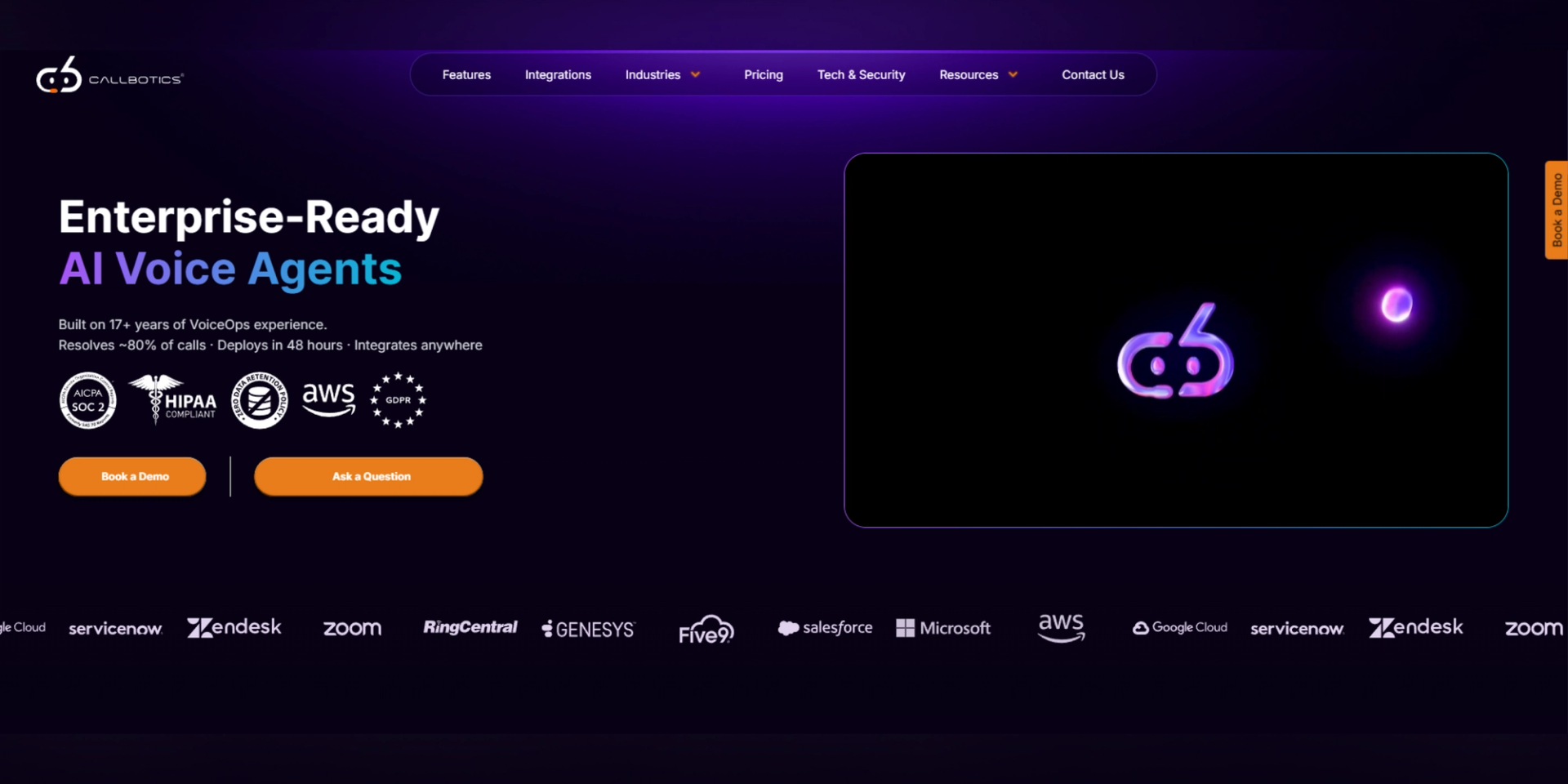
Source: CallBotics Homepage
For enterprises evaluating Sierra AI alternatives, CallBotics takes a fundamentally different approach to AI voice automation. Rather than emphasizing orchestration flexibility alone, CallBotics is built specifically for production-grade contact center environments where resolution rates, visibility, compliance, and operational stability matter from day one.
Here’s where CallBotics differentiates:
Sierra AI and CallBotics are built for different operational priorities. The right choice depends less on feature lists and more on your internal resources, workflow complexity, and deployment expectations.
Both platforms are powerful but optimized for different operational priorities.

Bryan is a B2B SaaS writer with a technical background who shifted into writing about technology and AI four years ago. With hands-on tech experience, he brings depth, clarity, and practical context to complex AI and SaaS topics. He’s a firm believer in an AI-driven future and focuses on content that explains not just how technology works, but why it matters. Outside of writing, Bryan enjoys watching films, listening to tech podcasts, and nurturing an unusual rookie-level interest in marine biology.
See how enterprises automate calls, reduce handle time, and improve CX with CallBotics.
CallBotics is an enterprise-ready conversational AI platform, built on 18+ years of contact center leadership experience and designed to deliver structured resolution, stronger customer experience, and measurable performance.